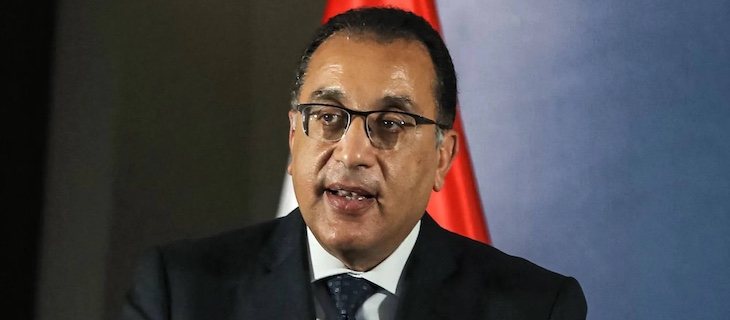
Prime Minister Mostafa Madbuly ended 2025 with the claim that he would reduce public debt to its lowest level in 50 years.
The state is “working to bring the debt-to-gross domestic product ratio down,” said the prime minister. “This issue is being handled forcefully and is under follow-up.”
Debt has emerged as a political challenge over recent years as the cost of borrowing has gradually increased, with debt service reaching 65 percent of total expenditure in fiscal year 2025/26.

State budget of the fiscal year 2025/26. Source: Draft budget and Mada Masr calculations
The trend comes as the pace of borrowing exceeds revenue growth. Between July and November of last year, expenditure on interest cost alone exceeded 96 percent of total revenues — LE1.061 trillion out of around LE1.1 trillion — according to the Finance Ministry’s latest available data.
While the target to reduce budget-sector debt to below 70 percent is not new, and exists, for example, as a target for FY 2029/30 in the Finance Ministry’s midterm fiscal strategy published at the end of last year, Madbuly’s intervention marks a renewed push to galvanize momentum toward the goal, which would mark the lowest debt-to-GDP ratio in five decades.
Days before his remarks, he attended a meeting with the president, Central Bank of Egypt Governor Hassan Abdalla and Finance Minister Ahmed Kouchouk that the presidential spokesperson said involved discussions on reducing the public sector debt-to-GDP ratio and “improving budget-sector debt indicators as well as the debt service bill.”
In the view of a parliamentary source with ties to the government, the push toward the goal could be merely the result of a short-term political effort to “boost Madbuly’s popularity at a time when he may be concerned about a rumored cabinet reshuffle.”
Regardless of the political intentions behind the prime minister’s pronouncement, the effect was a heated debate that spread rapidly through policy and media circles and saw commentators envision competing scenarios for Madbuly’s government to relieve the debt burden on the public budget.
The conversation also, and more importantly, touched on whether the target should truly be a fiscal priority — whether for Madbuly or for whoever succeeds him as the head of the government.
First and most notable of those throwing their hats in the ring with policy proposals was banker and businessman Hassan Heikal, who sits on Madbuly’s Macroeconomic Advisory Committee.
Heikal shared his proposal to reduce public debt in a photograph posted on X that showed a sketch on a piece of paper.
He suggested debt-for-asset swaps. Investors holding government debt would be invited to swap their debt instruments for shares in state-owned assets. These could include shares in state-owned companies that would be transferred to the Central Bank of Egypt.
The grand debt-swap proposal gained further traction this week after Cairo24, a state-affiliated outlet, published a report outlining what it described as the preliminary contours under government review of “the major step to reduce debt.”
The aim is to reduce public debt by LE600 billion to LE1 trillion, or around 3.4 percent of GDP, through two tracks, according to the outlet. One of these, described by the report as “close to happening” would involve a plan similar to Heikal’s: “swapping debt for equity in a company with an independent legal status.”
“High-quality, developable assets would be transferred to the company, while the entities participating in the debt swap would receive shares. The Finance Ministry would also contribute to the company’s capital.”
The assets expected to be transferred to the company include the Suez Canal Authority, the National Organization for Social Insurance, the Universal Health Insurance Authority, the National Bank of Egypt and Banque Misr, Cairo24 reported.
Transferred assets would also include a land plot in the Red Sea Governorate’s Zaafarana, in which the company would be allowed to invest directly, or create investment partnerships with Egyptian or foreign private-sector actors.
The Finance Ministry would also be permitted to sell shares in the company to the contributing entities following a capital increase.
According to the parliamentary source, the proposal leaked to the press this week is a development of Heikal’s earlier idea. The source said this updated version is likely being driven by the finance minister.
The source said that Heikal has already made the pitch to some of the most senior government figures, including the central bank governor, by whom the scheme was “met with outright rejection.”
Heikal defended the proposal during a session at the Economic Forum held at Cairo University’s Faculty of Economics and Political Science this month, with prominent economists and bankers in attendance, including former CBE Governor Mahmoud Abu al-Oyoun. Heikal argued that freeing the state budget of interest payments was necessary to expand public spending — particularly on healthcare.
Universal health insurance should cover the entire population, said Heikal. In his view, this would not be possible without a debt-swap plan like the one he proposed.
Asset sales alone — one of the main methods to raise government revenue proposed by international lenders, including the International Monetary Fund — would not resolve the interest burden on the budget, the businessman said, which far exceeds any potential valuation of those assets.
Heikal’s proposal was roundly criticized, however, on the grounds that it amounts to little more than a transfer of the debt burden — one standing in sharp contradiction to the principle of monetary policy independence from fiscal planning.
It was also argued that it conflicted with central bank laws since it would effectively render the bank indebted to the domestic banks it monitors by transferring to it the government debt held by those banks.
Moreover, opponents said that the proposal failed to address the root causes of the growth of public debt, which are tied to flaws in fiscal policy management.
The parliamentary source voiced the same criticism. In practice, the proposal aims to reduce only the portion of debt recorded in the state budget by shifting its burden elsewhere, the source said. The state’s liabilities would still exist, but in a different form.
A former parliamentarian echoed the same assessment, saying the plan reproduces a tendency to shift the burden of borrowing from ministries, whose budgets are part of the national budget, to entities that fall outside of it. Economic entities have been criticized for years for relying heavily on extra-budgetary borrowing that is ultimately guaranteed by the Finance Ministry, impacting the state budget.
The source said the guarantees provided by the Finance Ministry on behalf of extra-budgetary entities have become a risk to the state budget’s fiscal soundness, since the ministry is ultimately required to service those loans if the entities default.
A report published by Mada Masr in April, citing observations by the Central Auditing Organization on the final accounts of the FY 2023/24 budget, showed that some off-budget entities had already defaulted, forcing the Finance Ministry to step in and repay their debts.
“This new proposal, or other similar ideas, primarily benefit the Finance Ministry, as they improve the appearance of the state budget, the proper preparation of which is one of the ministry’s core responsibilities,” the source said. “Such ideas shift the burden of interest spending outside the budget, even though they do not alter the reality of the state’s liabilities in one way or another.”
The criticism has also been raised in the House of Representatives. Last week, MP Mohamed Fouad, a member of the House’s Economic Committee, submitted a briefing request regarding the government’s talk of “cosmetically improving indicators without reducing the real sovereign burden.”
As Fouad noted in his briefing request, in comments on the floated proposals, “swapping assets or liabilities within the scope of the general government does not, from the perspective of the Unified Public Finance Law, result in any net reduction in the sovereign debt burden, so long as those assets and debts remain within the same perimeter for which the state bears ultimate financial responsibility.”
About the Author