The fight against organized crime is now at the center of a trade war that has erupted between Colombia and Ecuador — one that will likely benefit only the region’s criminal actors.
On January 26, Ecuador’s government announced a 900% increase in the tariff for transporting Colombian oil. The measure followed President Daniel Noboa’s decision to impose 30% tariffs on imports from Colombia starting in February, arguing that the neighboring country is not doing enough on security. “This measure will remain in place until there is a real commitment to jointly confront drug trafficking and illegal mining along the border with the same seriousness and determination that Ecuador is showing today,” Noboa said on January 21.
In response, Colombia’s government announced the suspension of electricity sales to Ecuador and a similar tariff increase.
The border between the two countries is an important strategic area for organized crime, and military operations against drug trafficking, illegal mining, and smuggling are frequently carried out there. Colombia’s Minister of Trade, Industry, and Tourism, Diana Marcela Morales, said that “authorities in both countries had been holding talks to address border security issues” prior to the tariff announcement.
Echoes of Trump
The fight against organized crime has been placed at the center of an unusual regional trade war, mirroring tactics used by US President Donald Trump, who has frequently deployed tariffs to impose political pressure, divorced from commercial interests.
The trade war with Ecuador marks the latest in a series of diplomatic tensions affecting Colombia over organized crime and security policy.
For months, President Gustavo Petro has rejected the methodology used by the United Nations Office on Drugs and Crime (UNODC) to calculate coca leaf cultivation and, above all, the country’s potential cocaine production. As a result, future cooperation between Colombia and the UNODC on this issue could be at risk according to sources cited by El País.
Petro argues that the UNODC’s monitoring results — which in its latest report showed a 53% increase in potential cocaine production between 2022 and 2023 — explain why the United States decertified Colombia in the fight against drug trafficking in 2025. On October 24, the US Treasury Department also added Petro to the Office of Foreign Assets Control (OFAC) list, accusing him of maintaining links with organized crime. Petro and Trump are scheduled to meet at the White House on February 3.
Diplomatic Disputes Open the Door to Crime
As political leaders harden their stances, organized crime could benefit from the deterioration of regional cooperation.
Along the Colombia–Ecuador border, traders warn that tariffs could fuel smuggling. Personal care products, agroindustrial goods, fuel, and Colombian coffee are among the items expected to rise in price in Ecuador, potentially encouraging informal cross-border flows.
In the past, economic pressure measures, the withdrawal of financial support, and a lack of operational cooperation have weakened states’ ability to confront security challenges.
SEE ALSO: Why Trump’s Tariffs Won’t Slow the Flow of Migrants or Fentanyl From Mexico
By contrast, successful joint operations have shown that the transnational nature of organized crime can only be tackled effectively through cooperation.
According to Colombia’s Ministry of Defense, binational cooperation with Ecuador and intelligence sharing have led to the seizure of 286,161 kilograms of cocaine, 356 kilograms of heroin, and 4,615 kilograms of marijuana since 2023.
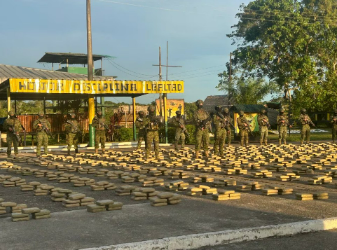
Featured image: The seizure of 2.4 tons of marijuana along the border between Colombia and Ecuador. Source: Colombian Ministry of National Defense
About the Author