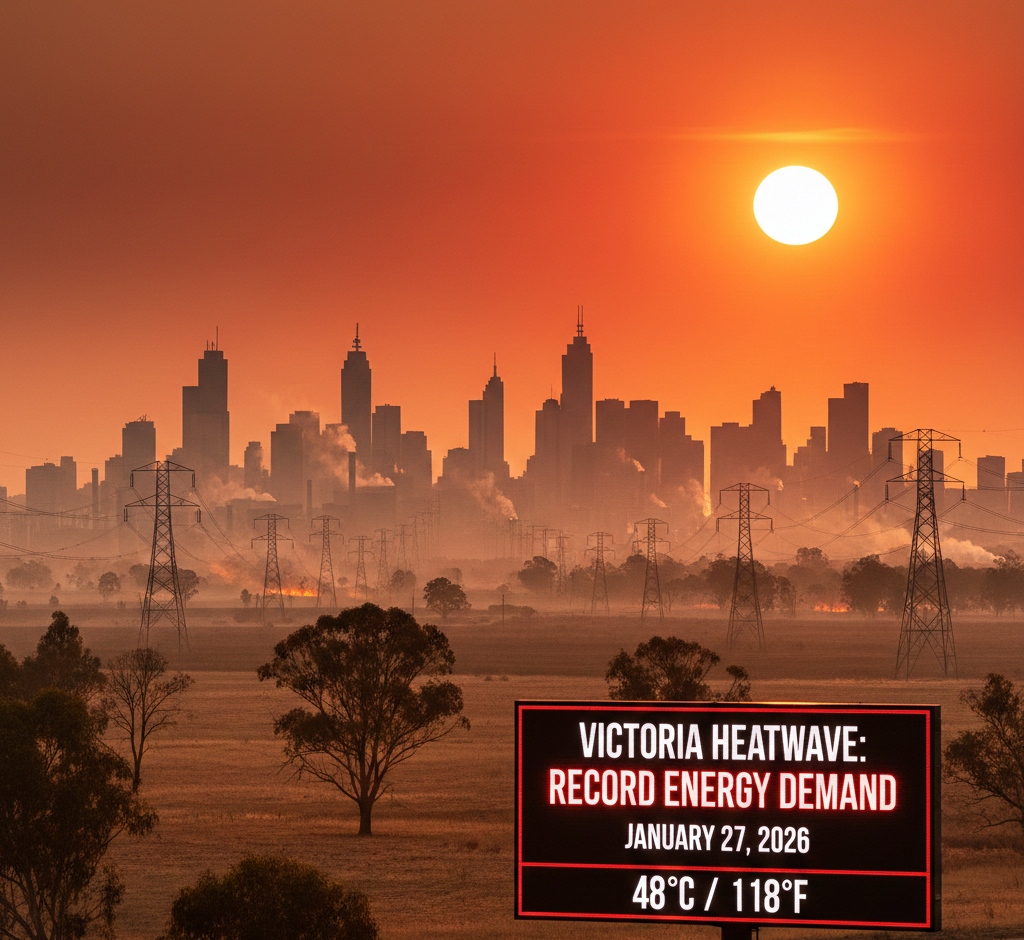
Victoria has officially set a new benchmark for energy consumption, surpassing a record that has stood for nearly two decades. As a brutal heatwave sweeps across the state, air conditioners are working overtime to keep residents cool.
Minister for Energy and Resources Lily D’Ambrosio confirmed the milestone this evening via social media. The previous record, set back in 2009, was finally eclipsed as the mercury soared and the grid faced its toughest test in years.
While the figures are still being finalised, the sheer volume of electricity being pulled from the network is staggering. This surge in demand highlights the ongoing challenges of managing a modern energy grid during extreme weather events.
A record-breaking evening for the grid
The previous record for peak demand in Victoria was established during the infamous heatwave of January 2009. For seventeen years, that figure remained the high-water mark for the state’s energy infrastructure.
That record is now history as the state’s population and reliance on electrical cooling have grown significantly. The surge began in the early afternoon and peaked as residents returned home from work and school.
Minister D’Ambrosio took to X to share the news with the public as the numbers began to climb. She noted that the system was being pushed to its limits but remained operational despite the immense pressure.
“Victoria has just broken its all-time record for electricity demand, surpassing the peak set in 2009.”
Lily D’Ambrosio, Minister for Energy & Resources, Victorian Government.
Outages impact thousands of Victorian homes
Despite the grid largely holding up to the record demand, the extreme heat has not been without its casualties. Thousands of Victorians are currently spending their evening in the dark as local infrastructure struggles with the load.
Data from the AusNet Outage Tracker shows a significant number of unplanned outages across the eastern suburbs and regional areas. As of tonight, over 35,000 customers are reported to be without power across their network alone.
The maps provided by CitiPower and Powercor show a similar story for the western suburbs and regional Victoria. Major hubs like Werribee, Point Cook, and parts of Geelong are seeing widespread service interruptions.
Infrastructure under the pump
The issue isn’t necessarily a lack of generation, but rather the physical stress on local transformers and poles. High ambient temperatures combined with high electrical loads can cause equipment to overheat and fail.
Recovery efforts are currently underway, with crews working through the night to restore services to the most affected areas. However, some residents have been warned that power may not return until the early hours of tomorrow morning.
In areas like Sunshine West and Tarneit, estimated restoration times are currently sitting between midnight and 3:00 AM. This makes for a very uncomfortable night for families trying to sleep in the stifling heat.
“Our crews are working as quickly and safely as possible to restore power to impacted customers.”
Spokesperson, Powercor.
The role of renewable energy and the SEC
The record-breaking demand comes at a time when Victoria is aggressively transitioning its energy mix. The State Electricity Commission (SEC) is at the heart of this strategy, aiming to bolster reliability through new projects.
Minister D’Ambrosio highlighted that the state’s investment in renewables is critical for moments like this. Solar and wind contributions during the day help offset the peak, though the evening ramp remains a challenge.
The push for household batteries and virtual power plants is expected to play a larger role in future summers. By decentralising storage, the pressure on the main transmission lines can be mitigated during these heat spikes.
What to do if you lose power
If you find yourself without power tonight, the first step is to check the official outage maps for your distributor. These sites provide real-time updates on estimated restoration times and the cause of the fault.
Keep your fridge and freezer doors closed as much as possible to maintain the temperature of your food. If you have a portable power bank, keep your devices charged in case you need to monitor emergency broadcasts.
Check in on elderly neighbours or vulnerable friends who may be struggling without air conditioning. Heat exhaustion is a serious risk during these extended periods of high temperatures and high humidity.
Looking ahead to the rest of the week
The weather forecast suggests that while the peak may have passed, temperatures will remain high for several days. This means the pressure on the Victorian energy grid is far from over.
Authorities are asking residents to be mindful of their energy use where possible, without compromising their health. Small actions like closing blinds early in the day can help keep internal temperatures down.
We will continue to monitor the situation as the distributors work through the backlog of faults. It serves as a timely reminder of the importance of grid resilience in the face of a changing climate.
For more information, head to https://www.outagetracker.com.au
About the Author