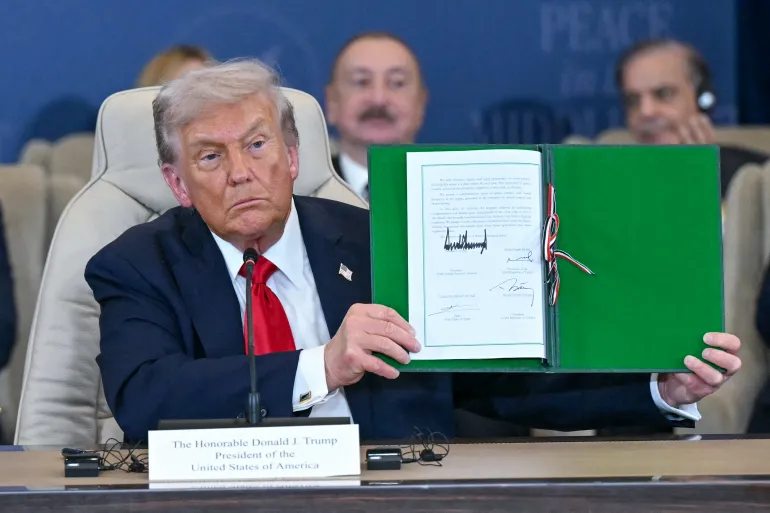

The White House announced on Friday the formation of two boards, tasking them with the management of Gaza’s affairs and assigning them to “operationalize the Board of Peace’s vision.”
The board, which gained an executive mandate to manage affairs in the strip from the United Nations Security Council in November, is set to oversee the second phase of the ceasefire in Gaza.
The step came just two days after a Palestinian committee tasked with directly administering Gaza, headed by former Palestinian Authority member Ali Shaath, held its inaugural meeting in Cairo.
The White House announcement sketches the roles and initial staff line-up of two bodies with very similar names: the Executive Board and the Gaza Executive Board.
These, along with any other committees or boards yet to be formed, will operate under the supervision of the Board of Peace, which is to be chaired by Trump himself, the announcement said.
Invitations have been extended to several world leaders to join the board, with its final composition yet to be determined.
Beneath the Board of Peace sits the Executive Board, responsible for “operationalizing the Board of Peace’s vision.” It is made up of seven members, including senior White House advisor and Trump’s son-in-law Jared Kushner, and former British Prime Minister Tony Blair — key architects of the post-war plan for Gaza.
Each member will oversee a specific portfolio, including governance capacity-building, reconstruction, regional relations, financing and investment.
Other members listed are:
- Marco Rubio, US Secretary of State and acting National Security Advisor to the US president
- Steve Witkoff, US special envoy to the Middle East and founder of real estate development firm The Witkoff Group
- Marc Rowan, billionaire CEO of private equity firm Apollo Global Management
- Ajay Banga, president of the World Bank Group, former board member of several organizations and co-founder of the Cyber Readiness Institute
- US Deputy National Security Advisor Robert Gabriel
To “support this operating model,” two senior advisors to the Executive Board were also named in the White House statement: former US Ambassador to Israel Aryeh Lightstone, who is also CEO of the Abraham Accords Peace Institute in Washington, and Josh Gruenbaum, a senior White House advisor.
The advisors, the White House statement said, will “lead day-to-day strategy and operations” and “translate the Board’s mandate and diplomatic priorities into disciplined execution.”
Security in the strip, according to the White House, will be led by Major General Jasper Jeffers, who is slated to command the International Stabilization Force in Gaza. In this capacity, he will “support comprehensive demilitarization and enable the safe delivery of humanitarian aid and reconstruction materials” while “establishing security, preserving peace and establishing a durable terror-free environment.”
Jeffers currently serves as commander of the US Special Operations Command Central and has previously held several senior posts, including deputy director for Special Operations and Counter-Terrorism at the Pentagon, and deputy commanding general of maneuver for the Third Infantry Division. He has taken part in major military campaigns in Iraq, Afghanistan and Syria, and was appointed by the US Central Command to oversee enforcement of the ceasefire between Israel and Hezbollah in Lebanon alongside US envoy Amos Hochstein.
The White House statement also establishes a “Gaza Executive Board” comprising 11 members, four of whom also sit on the Executive Board: Steve Witkoff, Jared Kushner, Tony Blair and Marc Rowan.
The remaining members are:
- Turkish Foreign Minister Hakan Fidan
- Advisor to the Qatari prime minister Ali al-Thawadi
- Egyptian General Intelligence Services head Hassan Rashad
- Emirati International Cooperation Minister Reem al-Hashimy
- Israeli billionaire and businessman Yakir Gabay
- Former UN Special Coordinator for the Middle East Peace Process Nickolay Mladenov
- UN Special Coordinator for the Middle East Peace Process Sigrid Kaag
Bulgarian diplomat Nickolay Mladenov is described by the White House as the “High Representative for Gaza,” who is to act as “the on-the-ground link” between the Board of Peace and the Palestinian administrative committee led by Shaath.

Structure of the Trump-led Board of Peace as outlined in the White House announcement.
Mladenov is also described as a member of the Executive Board and appears on the list of members of the Gaza Executive Board in the White House issue.
It is unclear how the remit of the two boards will relate to one another.
Both will operate under the broader umbrella of the Board of Peace, of which Trump, as chair, remains the only announced member.
Several countries announced that they have received invitations to join the board, including Turkey, which said that Trump had sent a letter inviting President Recep Tayyip Erdogan to join as a founding member of the board in a presidential statement released Sunday.
Jordan’s Foreign Ministry said Sunday that King Abdullah II had received a similar invitation, while Egyptian Foreign Minister Badr Abdel Atty said on Saturday that President Abdel Fattah al-Sisi had also been asked to join, describing the invitation as “an integral part of the requirements of phase two and the UN Security Council resolution.”
The Times of Israel published the Board of Peace’s founding charter, which it said was attached to the invitations sent out to several world leaders. The charter states that membership is limited to states invited to participate by the board’s chair and that each member state may serve a term of no more than three years.
It adds that the three-year limit will not apply to any state contributing more than US$1 billion to the Board of Peace within the first year of the charter’s entry into force.
Israel distanced itself from the announcement, despite the White House’s gesture that it intends to work “in close partnership with Israel, key Arab nations and the international community” to achieve the objectives of Trump’s plan.
Israeli Prime Minister Benjamin Netanyahu‘s office said on Saturday that Trump had not coordinated with Israel on the announcement of the Gaza Executive Board, adding that Israeli Foreign Minister Gideon Saar would speak with his American counterpart Marco Rubio regarding the board’s formation.
Hamas spokesperson Hazem Qassem told Mada Masr that Israel’s explicit opposition to the formation of the Gaza Executive Board reflects its clear intention to obstruct the ceasefire agreement, especially with its continued breaches of the deal.
This, according to Qassem, has pushed the group into ongoing contact with mediators. Hamas sees the International Stabilization Force’s primary roles as “preventing aggression and interposing between the Israeli occupation and the Palestinian people” and “entrenching the ceasefire and monitoring its implementation,” he said.
Qassem said Hamas rejects “the logic of international and external guardianship,” stressing that “these arrangements must lead to a unified Palestinian political system based on pluralism and democracy.”
With the Board of Peace still incomplete, Hamas awaits clarification on its role, its relationship with the other bodies and formations stemming from it, and its connection to Gaza’s technocratic committee, according to the spokesperson.
Hamas understands that “the board’s main role will be mobilizing support for reconstruction of the entire Gaza Strip in a transparent and professional manner, without discrimination between the strip’s different areas,” Qassem added.
In November, the UN Security Council adopted Trump’s plan to end the war in Gaza, with 13 members voting in favor and Russia and China abstaining. The move granted Washington UN cover to carry out the terms of the plan it proposed for the ceasefire announced in October.
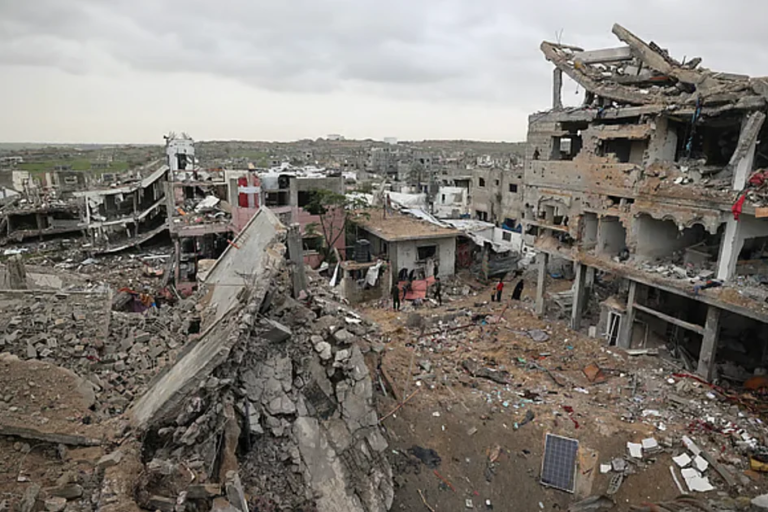
The resolution authorizes the Board of Peace to assume transitional administration of the decimated strip, empowering it over and above Palestinian self-determination. Under the resolution, Palestinian decision-making is confined to a “technocratic, apolitical committee” of Gaza-based Palestinians unaffiliated with Hamas or the Palestinian Authority. The committee is answerable to the board and limited to “tasks of day-to-day civil service and administration.”
As for the International Stabilization Force, the resolution authorizes it “to deploy under unified command acceptable to the Board of Peace” in consultation with Egypt and Israel, with a two-year mandate to “use all necessary measures,” meaning force, to secure the borders and protect civilians.
About the Author