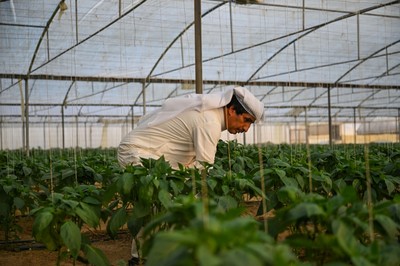

Kuwaiti farmer Sari Al-Azmi works at his farm in Ahmadi Governorate
KUWAIT CITY, Jan 18: Farmer Nasser Saad Al-Jarri (Abu Bader) is recognized as one of the pioneering farmers in the Al-Wafra agricultural area. His late father, Saad Mubarak Al-Jarri, was among the first farmers in the coastal village of Abu Halifa in the 1950s, before the discovery of oil transformed the area into the modern city of Abu Halifa, reports Al-Seyassah daily.
In those early days, farmers from Abu Halifa transported their diverse agricultural produce to Safat (now Darwazat Al-Abdul Razzaq) every morning on camels. It used to be a long and arduous journey that took about ten hours. They would rest briefly at what is now Souk Al-Manakh before beginning the return trip to the coastal farms of Abu Halifa.
For Nasser Saad Al-Jarri, as for many members of the Al-Jarri family, farming is an integral part of life. Bader Saad Al-Jarri (Abu Jassim) served as Vice President of the Kuwait Farmers Union. Saad Al-Jarri was a prominent farmer in Abu Halifa in the 1950s, supplying daily produce to Kuwait City. Following in his father’s footsteps, Nasser has become a leading farmer, producing thousands of tons of agricultural products daily from his extensive farm overlooking Street 500 in Block 6 of the Al-Wafra agricultural area in south of Kuwait.
On Nasser Al-Jarri’s farm, there are large enclosures for raising sheep and poultry, with a particular focus on pigeons. Farmer Al-Jarri hopes that competition in the auction will start based on the cost of each agricultural product, a method he says ensures a fair profit for producers after covering their expenses. He called for giving priority to local produce in Al-Wafra and Sulaibiya markets, and praised some cooperative societies for allocating space to display locally grown products. He also requested that the price gap between local and imported agricultural goods not be too large. Al-Jarri highlighted the issue of subsidized diesel, commending the Kuwait Farmers Union for its efforts to reinstate subsidized diesel for farmers in Al-Wafra and Al- Abdali. He revealed that he currently spends around KD 1,000 per month on diesel, but the cost would drop to no more than KD 500 if subsidized diesel were available.
Meanwhile, farmer Mansour Sayer Al-Shammari has proposed a series of measures to tackle the chronic problems that farmers in the Al-Abdali agricultural area in north of Kuwait face, particularly the shortage of treated irrigation water, reports Al-Seyassah daily. Al-Shammari suggested allocating two days each week for delivering treated water to every plot of land in the region. He also called for the quick reinstatement of subsidized diesel for agricultural producers and urged authorities to resolve the frequent and sudden power outages that disrupt farming operations.
In addition, he expressed hope that the recently introduced high fees for bringing in agricultural workers would be canceled. Highlighting the competitiveness of local produce, Al-Shammari stressed that he is not concerned about imported products, provided that the guiding principle remains “Quality in production and integrity in marketing.” He stressed that locally grown produce reaches consumers fresh, healthy, and safe, giving it a clear advantage in the market. Al-Shammari explained that his farm produces a wide variety of crops throughout the year, with planting cycles scheduled in close succession. The farm’s total agricultural area is estimated at around 200,000 square meters, all covered by modern, cooled greenhouses established in partnership with the agricultural financing portfolio he manages on behalf of the Ministry of Finance and the Industrial Bank of Kuwait. His farm production includes cabbage, eggplant, potatoes, onions, corn, squash, beans, peas, sunflowers, broad beans, cauliflower, carrots, zucchini, and various leafy greens. Al-Shammari emphasized that the farm could cultivate even more varieties if it had reliable access to treated water, subsidized diesel, electricity, and trained agricultural labor at reasonable wages. He explained that the farm currently requires about 20 water tankers daily to transport fresh water from its main stations at high costs. The price of a 300,000-gallon water coupon has risen from KD 51 to KD 151, making it prohibitively expensive.
Al-Shammari also questioned why the use of desalination plants on farms is prohibited, particularly given the ongoing treated water shortage in Al-Abdali.
About the Author