
The smarter way to build your season without setbacks.
One of the most dangerous phases of any season isn’t race day. It’s
the build.
As training volume ramps up, most athletes don’t get injured from one
big moment they get taken out by small niggles that pile up when load
increases faster than the body can adapt.
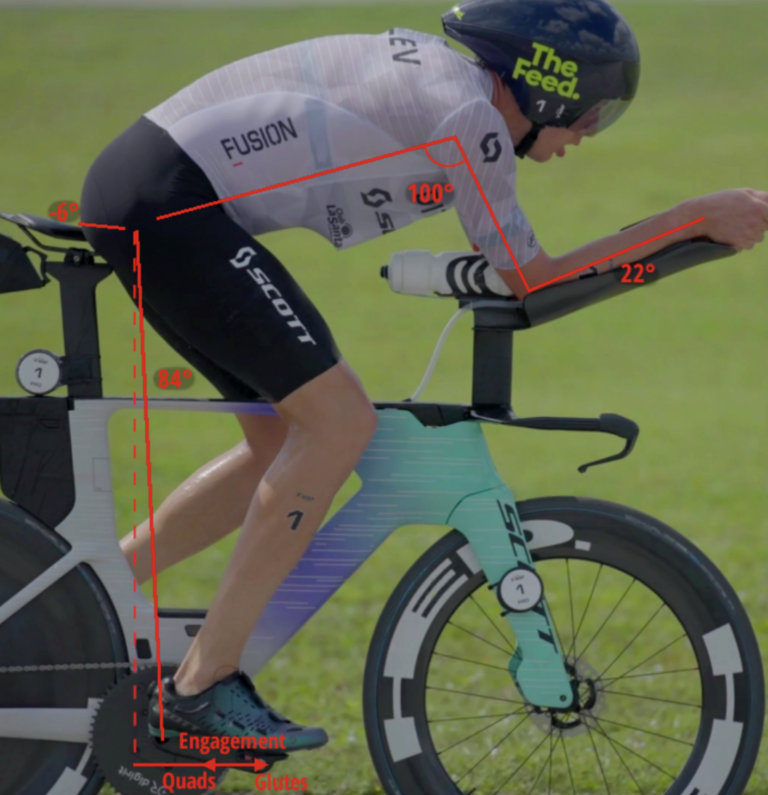
Sam Long knows this firsthand.
“WHENEVER A SMALL ISSUE SHOWS UP, LEVER HELPS ME KEEP MOVING. TAKING A
BIT OF BODYWEIGHT OFF MEANS I CAN KEEP TRAINING WITHOUT FORCING TIME
OFF.”

After last season, a flare-up in his right hip nearly shut things down.
And yet Sam didn’t just survive the year… He won 70.3 La Quinta and
ran 1:10 off the bike. And here’s the part most people don’t
realize:
“I ONLY RAN ON THE LEVER FOR 5 OR 6 DAYS LEADING UP. I DIDN’T KNOW
WHAT MY RUN WAS GOING TO BE LIKE.”
He didn’t build that race on pounding road miles. He built it by
keeping his training stimulus high while managing load on his body.
THE REAL PROBLEM: MILEAGE RAMPS FASTER THAN TISSUE ADAPTS
Here’s what the research shows:
– Bone, tendon, and connective tissue adapt much slower than your
aerobic fitness.
– Sudden mileage increases significantly raise injury risk.
– Most overuse injuries happen during build phases, not racing.
Studies consistently show that reducing impact forces while maintaining
training volume allows:
– Higher consistency.
– Better tissue tolerance over time.
– Fewer forced rest days.
In simple terms: Your engine can handle more before your chassis can.
That’s where bodyweight support changes the game.
WHAT SAM IS DOING RIGHT NOW
As Sam builds toward a big 2026 season, he’s:
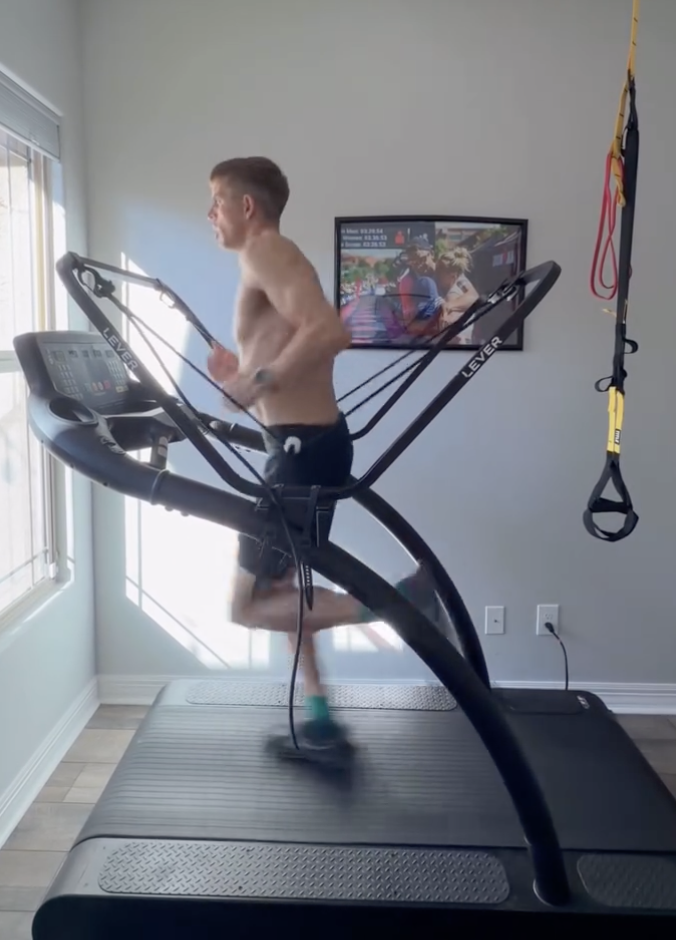
– Logging 60–70 minute runs on LEVER.
– Taking up to 20 lbs of bodyweight off.
– Keeping volume high while controlling joint and tissue stress.
– Using LEVER whenever something feels “not quite right” before it
becomes a real problem.
“IT’S A MUST-HAVE IN MY GARAGE.”
This isn’t about replacing your outdoor runs. It’s about
strategically managing load so you can keep stacking weeks instead of
resetting them.
THE SCIENCE BEHIND IT
When you reduce bodyweight by even 10–20%:
– Ground reaction forces drop significantly.
– Joint loading decreases.
– Tendon and bone stress decrease.
– While cardio, neuromuscular patterns, and running mechanics stay
nearly identical.
Research on bodyweight-supported running shows athletes can:
– Maintain VO₂ stimulus.
– Maintain stride mechanics.
– Accumulate more total volume.
– With less mechanical stress per step.
That’s not a shortcut. That’s smart load management.
WHY THIS MATTERS FOR YOU
If you’re:
– Building toward a spring race.
– Increasing mileage right now.
– Coming off downtime.
– Or trying to stay ahead of the usual “build phase niggles”.
This is exactly when LEVER is most valuable. Not when you’re broken.
When you’re trying to avoid breaking.
Posted on 18th Jan 2026
About the Author