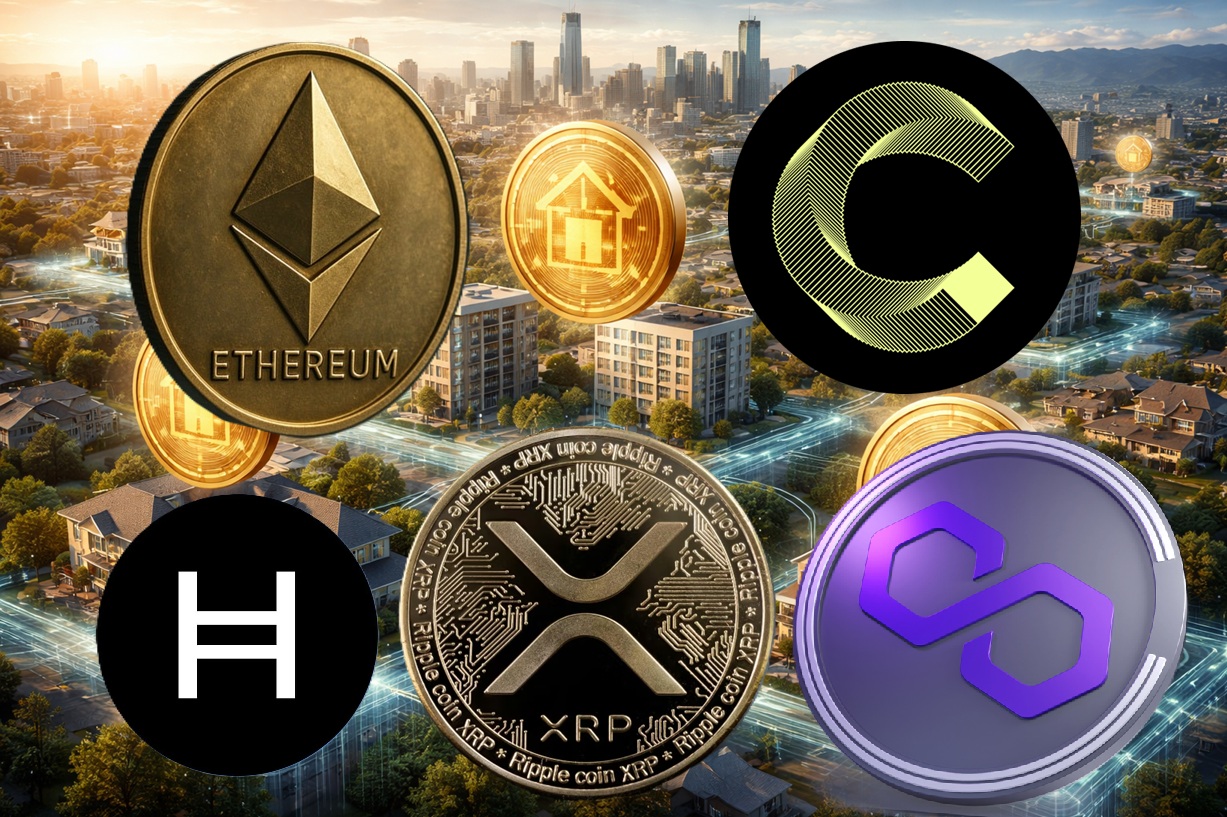
- Financial giants and Web3 institutions are racing to get ahead of the real estate tokenization boom.
- Canton Network has emerged as a breakout star, now accounting for a $342.9 billion share of the $362.7 billion RWA industry.
- Ethereum, Polygon, and Solana are also leading the charge, with XRP Ledger and Hedera rapidly climbing up the ranks.
Real-world asset (RWA) tokenization is no longer just the next frontier in Web3. It’s already rapidly transforming industries.
Borrowing Robinhood Markets CEO Vlad Tenev’s previous description of RWA, it’s an “unstoppable freight train” that will soon run over the market. It’s more than just a trend; it’s democratizing, streamlining, and providing round-the-clock access to global capital markets in ways that legacy or traditional finance (TradFi) institutions can’t.
One of the hot topics in RWA discussions is real estate tokenization.
What is Real Estate RWA Tokenization
Real estate tokenization converts property ownership or rights into tokens via blockchain technology. It enables fractional ownership, improved liquidity access, and seamless transfer of high-value real estate assets.
The process opens participation of both investors with minimal capital and large institutions in the industry. For property owners, it allows them to unlock liquidity from the illiquid nature of their real estate without necessarily having to sell their entire property. It also departs from the traditional landlord model, as smart contracts set programmed rules that automate actions such as payments (e.g., rent) and transfer restrictions.
Tokens can be traded on digital marketplaces, reducing friction associated with the traditional, siloed nature of property markets, which are often complicated by intermediaries.
Top 5 Blockchains for Real Estate Tokenization
The success of a real estate tokenization project is grounded in a blockchain that balances performance, compliance, accessibility, security, and efficiency. Hence, developers and institutions must weigh these factors carefully when choosing the platform that best aligns with their goals.
If you are on the lookout for tokens that could benefit from the incoming real estate tokenization boom, these are worth considering.
1. Canton Network (CC): A Breakout Star
The Canton Network, underpinned by the Broadridge DLR (Distributed Ledger Repo) platform, immediately shook the market dynamics for RWA tokenization. With barely three years up its sleeve since launch in 2023, it has already taken a huge slice in this category.
To date, RWAs in Canton have risen to 8,006, accounting for more than $342.9 billion of the $362.7 billion industry, according to RWA.xyz data. The chain is backed by a consortium of TradFi heavyweights, such as Goldman Sachs, JP Morgan, Deutsche Bank, BNP Paribas, LSEG, Cboe, and more. Meanwhile, tokenized real estate projects are actively being developed on Canton by the likes of Black Manta Capital Partners and T-RIZE.
Canton’s main drawback, though, is its permissioned network. Additionally, its tokens have limited interoperability within decentralized finance (DeFi) and are particularly suited for institutional investors.
2. Ethereum (ETH): The Institutional Gold Standard
Ethereum, despite having many competitors and with some of them even claiming to be ETH killers, remains one of the most dominant forces in RWA tokenization. Its resilience stems from continuous upgrades that enable it to scale across diverse RWA project models.
The battle-tested chain offers deep liquidity and unparalleled security. It trails Canton in RWA tokenization, with 643 related projects valued at $12.9 billion.
Ethereum has the deepest DeFi ecosystem, including Aave (AAVE) and Uniswap (UNI), where participants can use tokenized assets as collateral. However, the Layer 1 (L1) chain is prone to high gas fees, especially during high system traffic.
3. Polygon (POL): Scalability Meets Ethereum Security
Polygon is the go-to for platforms that want the security of Ethereum but need to support high-frequency trading and small-scale investors. The Layer 2 (L2) chain built on Ethereum is utilized by platforms like multifamily real estate investing platform HoneyBricks and white-label real estate tokenization platform Tokenizer.Estate.
The chain boasts near-zero transaction fees and instant finality. This allows property owners to distribute monthly rental yields to thousands of token holders for just a few cents in total fees. Polygon currently houses 282 RWAs valued at $1.1 billion.
The caveat here is that Polygon’s centralization has often been a subject of debate. Moreover, its platform is best suited for retail, as institutions usually prefer the finality of a dedicated L1.
4. Solana (SOL): High-Performance Trading
With the rise of its Token Extensions in 2025, Solana has become a serious contender for RWA. The chain has built its architecture for speed and high throughput. The network is best for high-volume secondary markets and PropTech (Property Technology) apps that require a seamless, fast user experience. It features low fees and 24/7 high-speed trading.
Solana’s new token standards include “permanent delegate” and “transfer hook,” which make it much easier to enforce legal restrictions directly on the token. As a result, it has grown to host 306 RWAs totaling $1.1 billion. Notable projects in the network that host tokenized real estate include Homebase and MetaWealth.
Solana, however, faces criticism for its history of network stability issues and perceived centralization, given its smaller set of high-performance validators compared to Ethereum.
5. XRP Ledger (XRP) and Hedera (HBAR): Emerging Contenders
The XRP Ledger provides native support for tokenization without requiring smart contracts for basic issuance. Furthermore, it has a built-in decentralized exchange (DEX).
The aforementioned features facilitate the efficient settlement of cross-border real estate dividends. One of the most significant real estate tokenization projects to emerge on XRPL is the Dubai Land Department (DLD) and Ctrl Alt’s Prypco Mint initiative, supported by the Virtual Assets Regulatory Authority (VARA), the Central Bank of the UAE, the Dubai Future Foundation, and Zand Digital Bank.
On the other hand, Hedera’s fixed-fee model, denominated in USD but paid in HBAR, offers an alternative for enterprises that prefer a predictable operating cost for their long-term operations. It is emerging as a favorite for recording auditable deeds and title histories.
Hedera has active partnerships with RedSwan for tokenizing commercial real estate and Swarm for bridging real estate tokens to DeFi.
Disclaimer: The analysis and commentary featured in this article are only for informational purposes. They do not constitute financial advice or a product recommendation from the author or the Blockzeit team.
What’s your Reaction?
+1
0

+1
0

+1
0

+1
0

+1
3

+1
0

+1
0
About the Author