 Starring: Ralph Fiennes, Jack O’Connell and Ralfie Williams
Directed by: Nia DaCosta
Rated: R
Running Time: 109 minutes
Sony Pictures Releasing
Our Score: 4 out of 5 Stars
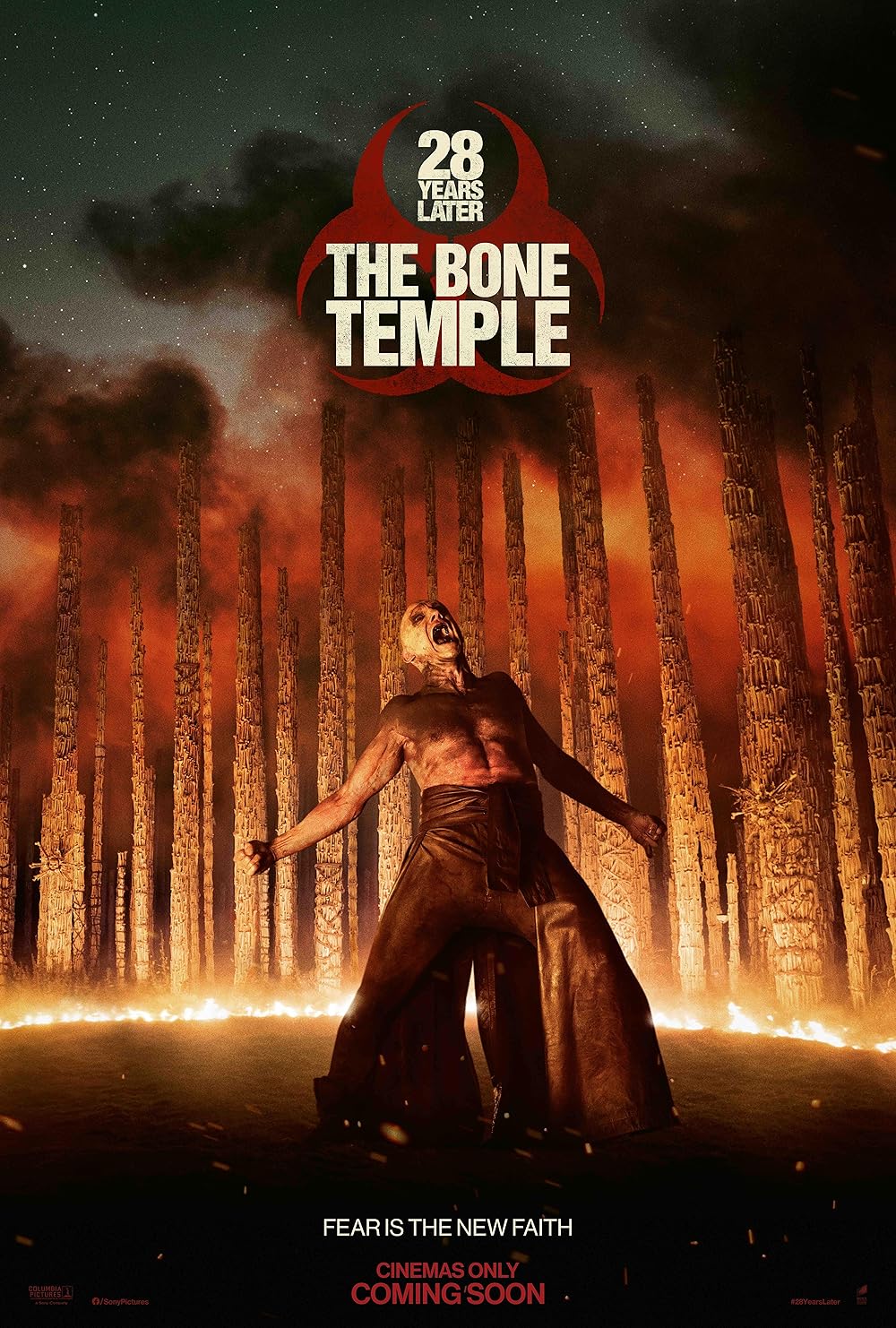
In my review of “28 Years Later,” I noted that the film needed “Bone Temple” to really understand what Alex Garland was aiming for. I still don’t fully know, but this film offers a lot more to chew on. Picking up right where the prior film ended, we learn that the soccer-hooligan-looking “Warriors” gang is actually a Satanist cult (I wasn’t expecting that either). Led by Sir Lord Jimmy Crystal (Jack O’Connell), they force Spike (Alfie Williams), the lead of the prior film, into a ritual built around the simple principle of kill or be killed. Meanwhile, Dr. Ian Kelson (Ralph Fiennes), creator of the titular bone temple, begins to bond with the infected Alpha from the previous film, whom he names Samson (Chi Lewis-Parry). Again, I wasn’t expecting that either. These two threads converge in what I can only describe, without spoilers, as the greatest use of an Iron Maiden song on film.
What fascinates me about these new “28 Years Later” entries is the way Garland keeps trying to deconstruct the zombie genre the same way “28 Days Later” detonated it two decades ago. This time, Nia DaCosta is the one corralling his ideas, and the tonal shift is noticeable. The editing isn’t a gore-splattered machine gun over London backwoods; DaCosta brings more humanity without imitating Danny Boyle, making the film more watchable without defanging it.
What’s most surprising is that “Bone Temple” behaves like a counter-middle chapter. Yes, it’s technically the fourth film, but “28 Years Later” is being shaped as a trilogy. And instead of going darker, “Bone Temple” goes more hopeful. Spike’s path pulls him deeper into Jimmy Crystal’s orbit, where apocalypse becomes an opportunity for domination. On the other end, Dr. Kelson humanizes the infected, believing empathy might be the only way out of hell. Fiennes has a blast playing a loner who decides to befriend the most lethal cannibal alive. Together, these arcs reduce the apocalypse to two pathways: brutal control or stubborn compassion.
If that sounds simplistic, it’s deliberately so. Garland has always flirted with the big themes, militarism, pandemics, survivalism, etc., but here the real axis is science vs. religion. Kelson embodies the scientific impulse, acknowledging science’s role in creating the nightmare while believing it is also the way out. Crystal embodies faith. He believes faith is why the world has crumbled like tissue paper and he has adorned himself as a messiah figure to lead the way. Even at the end of the world, the two remain in conflict, and religion happily weaponizes science when it serves its power.
All of this leaves a single question: where do we go in the final film? After “28 Weeks Later” jammed conflicting themes and styles together, “Bone Temple” gives the series a breather. It’s still bloody and bizarre, but it’s also personal and weirdly optimistic. For the first time in the franchise, perception becomes the enemy. That makes Garland’s landing in the final film that much harder.
About the Author