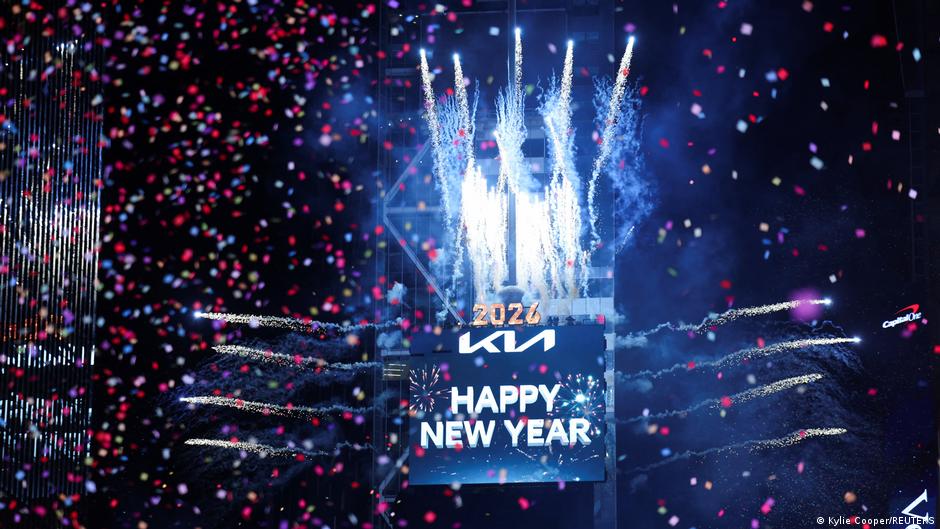
Berlin, Hamburg and Munich have led Germany’s celebrations to mark the start of 2026.
Although the usual huge New Year’s Eve show in the capital was moved to Hamburg, due to funding being pulled by the Berlin state government, the city still lit up at midnight with an impressive fireworks display lasting 7 and a half minutes.
Hamburg took the responsibility for the traditional stage show aired on national TV, featuring top international and German talent, along with a huge fireworks display on the Elbe River.
In France, visitors to Paris were treated to a video mapping light show projected onto the Arc de Triomphe ahead of the midnight fireworks. In 2026, the city marks the 70th anniversary of the Paris-Rome sister city relationship, with many events planned.
Not far away, Disneyland Paris also launched a new midnight fireworks show over the castle.
In Spain’s capital, Madrid, tens of thousands of people gathered in Puerta del Sol, the bustling central square, to mark the opening of 2026.
An incoming ban on home fireworks in the Netherlands gave residents and tourists a final legal way to light up the sky with their own pyrotechnics.
Amsterdam organized a free electric fireworks show at Museumplein (Museum Square) as well as a spectacular eco-fireworks and sound display. The show is reported to be cleaner for the air and safer for animals, who are often disturbed by the noise.
Poland’s capital, Warsaw, meanwhile, maintained its policy of no official municipal fireworks. While the skies lit up with numerous private displays, crowds gathered in the Old Town for casual street parties and live music.
Germany, France, Poland, Spain, Italy the Netherlands, Norway, Sweden, Croatia, Bosnia and Herzegovina, Serbia, Albania, Hungary and a number of other countries all welcomed the new year at UTC 2300.
About the Author