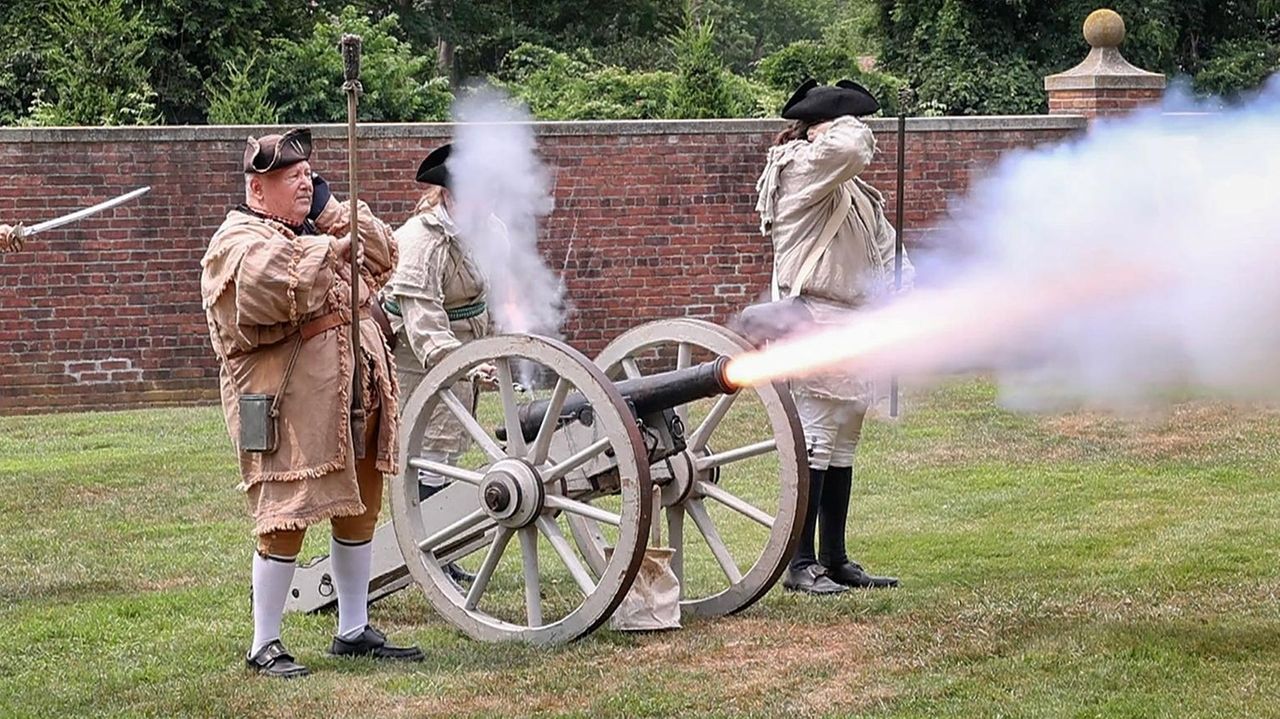
As the United States nears its 250th birthday, scores of events are planned for Long Island, whose Revolutionary history — it was the site both of yearslong British military occupation and a major Continental Army intelligence-gathering effort — is among the most complicated of the war.
Some of it is captured in Suffolk County 250th Commemorative Planning Committee’s guidebook of historic sites and exhibitions, which includes roughly 100 Suffolk County entries, plus 11 for state parks across the Island and eight entries from Nassau County. The guidebook’s creators designed it as a keepsake; visitors will collect a unique passport-like stamp at each location. It is available in hard copy for $8.32 or free as a PDF.
What are the stakes of a national commemoration at this moment in this nation’s history?
High enough that there are at least two national-level planning groups, including the White House’s Task Force 250, on whose website officials say they are “encouraging the entire federal government, state and local governments, the private sector, non-profit and educational institutions, and every citizen across this country to join in this historic celebration. Task Force 250 invites citizens to have a renewed love of American history, experience the beauty of our country, and ignite a spirit of adventure and innovation that will raise our nation to new heights over the next 250 years.”
WHAT NEWSDAY FOUND
- Events commemorating the 250th anniversary of the Declaration of Independence and the Revolutionary War are planned for dozens of sites across Long Island.
- Suffolk County officials and historians are doing much of the coordination and promotion for the events and have published a guidebook.
- Event planners hope the 250th will renew interest in Long Island history. Some say a focus on the nation’s founding ideals will help Americans find “common ground.”
The task force launched in January 2025, days after President Donald Trump was inaugurated. It began following through on campaign promises to slash the federal workforce and cut spending on programs Trump and his advisers deemed nonessential or wasteful.
In July, John Dichtl, president and CEO of the American Association for State and Local History, warned in a note to members that those cuts included grants vital for historic inquiry, and that the White House’s work on the 250th invested “in the anniversary’s symbolic power while touting a narrow vision of what American history is and how it should be commemorated and taught.”
No federal funds sought
In an interview this week, Hofstra University historian Sally Charnow said she and her colleagues had considered seeking federal grant money for the university’s 250th commemoration but “realized our project didn’t fit well into the kind of work they were interested in funding.” Several others said their organizations were not seeking grants from government commemoration commissions but were using operating funds or other grant sources.
Planners of some of Long Island’s celebrations said the 250th was a chance to correct cherished but incorrect stories of the region’s past that spread around the 200th anniversary, in 1976, including some about acts of patriotic heroism that were more legend than fact. Others described it as a once-in-a-generation opportunity to grow interest in Long Island history and shore up what Justinne Lake-Jedzinak, director of education and public programs at Oyster Bay’s Raynham Hall Museum, called the “historic infrastructure” of sites, archives and museums.

Revolutionary War reenactors in formation alongside the Suffolk County Sheriff Office’s color guard during a Declaration of Independence ceremony at Sagtikos Manor in West Bay Shore on Aug. 6, 2025. Credit: Newsday/John Paraskevas
Some said the stakes were higher.
“This comes at a time when our survival as a nation requires us to find common ground,” said Steve Israel, the former Democratic congressman representing Huntington who runs Theodore’s Books, an Oyster Bay bookstore, and served on the New York State 250th Commemoration Commission.
“This is an opportunity to reacquaint ourselves with the founding principles of our country and make our own judgments on whether we have fallen short or remained faithful to them,” Israel said.
The store will partner with Raynham to host speakers on a variety of Revolutionary War topics, including espionage, starting Monday with an appearance at the museum by author Tim Weiner, a former New York Times reporter whose most recent book is about the Central Intelligence Agency in the 21st century.
Guidebook’s preface
Long Island’s Revolutionary War history ranges from distant CIA antecedent and “famed Culper Spy Ring of Setauket to the British-occupied lands of the South Shore,” Suffolk County Executive Edward P. Romaine writes in the guidebook’s preface. Elsewhere, the text describes “a deeply fractured society where neighbors often stood against each other.”
This local history does not square easily with a triumphalist understanding of the war in which American patriots united to throw off the yoke of British tyranny. For roughly seven years after the Continental Army’s defeat in the Battle of Long Island in 1776, Long Islanders lived under cruel British military occupation, but the occupiers included armed Loyalists from the colonies; Queens County, which then included Nassau, had strong commercial and religious ties to England and some of the most loyal royal subjects on the continent.
Thousands of Long Islanders who supported the patriot cause fled to Connecticut when the Revolution began and thousands of Loyalists fled when it ended (many to Canada). Long Island’s population included, on the eve of the war, several thousand Black people, some of them enslaved, for whom the War of Independence did not result in independence; full emancipation for them did not come until 1827.
After the shooting stopped, New York’s State Legislature levied a 37,000-pound sterling tax on the region for not supporting the war effort.
Today, the Daughters of the American Revolution maintains a dedicated webpage for descendants of Revolutionary-era residents of Long Island and New York City who wish to join the organization, admonishing them to “review multiple sources to ensure that their ancestor did not take an oath to the King, or furnish aid to the British in any fashion AFTER performing his or her patriotic service,” though the force of an oath signed under duress of military occupation might be questioned.
Against that backdrop, the Heckscher Museum of Art in Huntington will open its Biennial this spring, inviting Long Island artists to “submit art that resonates with the legacy of the Declaration of Independence, in all its promises, ideals and contradictions,” according to the museum website.
“There will be historic associations in other parts of Long Island that will have displays and celebrations of historic objects,” Heather Arnet, the museum’s executive director, said in an interview. She intends, instead, to start “conversations” through art, she said. “We hope that museums are spaces where communities can come together to engage in dialogue and exchange ideas.”.
Reexamine founding ideals
Revolutionary commemoration can be, as Israel suggested, an occasion to reexamine the evolution of our founding ideals; another response is to examine the material history of the founding era. The Long Island Museum in Stony Brook, in an exhitition titled “The Seat of Action,” will show about 100 pieces, including period coins, munitions and weapons found in archaeological digs of British and Loyalist forts on Long Island. The exhibition will include a painting of Culper leader Benjamin Tallmadge not previously displayed on Long Island and one of the only paintings of an enslaved person made in New York in that era, showing Tamer Wren, a Black woman who was enslaved by the Mills family of St. James and worked for them after her manumission in the early 1800s.

Michael Grillo, portraying George Washington, reads a Washington speech to the crowd gathered at Sagtikos Manor in West Bay Shore on Aug. 6, 2025. Credit: Newsday/John Paraskevas
A second exhibition, “Enduring Heart,” will display historical household objects used by Long Islanders from the Unkechaug, Shinnecock and Montauket nations, along with work by 20 contemporary Native American artists. One of the salient but underexamined post-Revolution experiences for Native Long Islanders was “continuing loss of land,” said Joshua Ruff, the museum’s co-executive director. For them, as for many Long Islanders who lived through the war, “there is some pain in the record,” Ruff said. “You can’t gloss it over and talk about the sort of hero history of the war.”
Untold or little-told stories are central to the themed tea that Georgette Grier-Key, executive director of Sag Harbor’s Eastville Community Historical Society is planning for this March. Inspired by conversations with archaeologist friends who told her of the anthropological value of china shards at dig sites that their predecessors once discarded, the event will examine historical American women who found ways to exert agency before and after they had the right to vote. “They did have influence, and they could use it in entertaining, talking and teatime,” said Grier-Key, also a member of the state commission. “This is an unfinished revolution — these women were not considered to have done anything.”
Practice of commemoration
Some organizers are using the 250th as an opportunity to examine the practice of commemoration. Freeport Memorial Library archivist Regina Feeney’s robust website of digital 250th resources includes “History of New York During the Revolutionary War,” written in 1879, and links to hundreds of images from the village’s 1976 Bicentennial celebrations. The site also has articles about South Hempstead during the Revolution and lists of Patriot and Loyalist residents, though Freeport did not incorporate until 1892.
Using a trove of local newspapers archived online for an upcoming project, Babylon Town historian Mary Cascone is researching the ways in which residents in 1876 and 1976 commemorated the nation’s birth. In 1976 and the years before, “there was a lot of fervor — ‘We’ve got to celebrate, let’s publicize our information’ — and we found that a lot of misinformation was put out there,” she said. “They wanted to try to embrace the past. The responsibility we have now is to look at it with the knowledge that we have.”
Amid the exhibitions, reenactments and lectures, Hofstra will wade in with programs of its own, including an exhibition at the Emily Lowe Gallery, “Our Unfinished Revolution(s),” putting art by William Hogarth, Alexander Calder, Faith Ringgold and Jeremy Dennis alongside historic diaries and primary documents of indentured servitude and slavery.
The university is also offering a slate of classes to its students on the American Revolution and political revolutions generally. Lectures open to the public will address American constitutionalism at 250 and the French, Haitian and Latin American revolutions of the 18th century that influenced or were influenced by the one in North America.
“Commemorating this moment historically begs us to continue to ask these questions — what does American democracy stand for, what is the promise of the Declaration of Independence, who’s part of our political community, who’s not, how have people fought for their rights in this country,” said Charnow, chair of the university’s History Department.

Nicholas Spangler is a general assignment reporter and has worked at Newsday since 2010.
About the Author