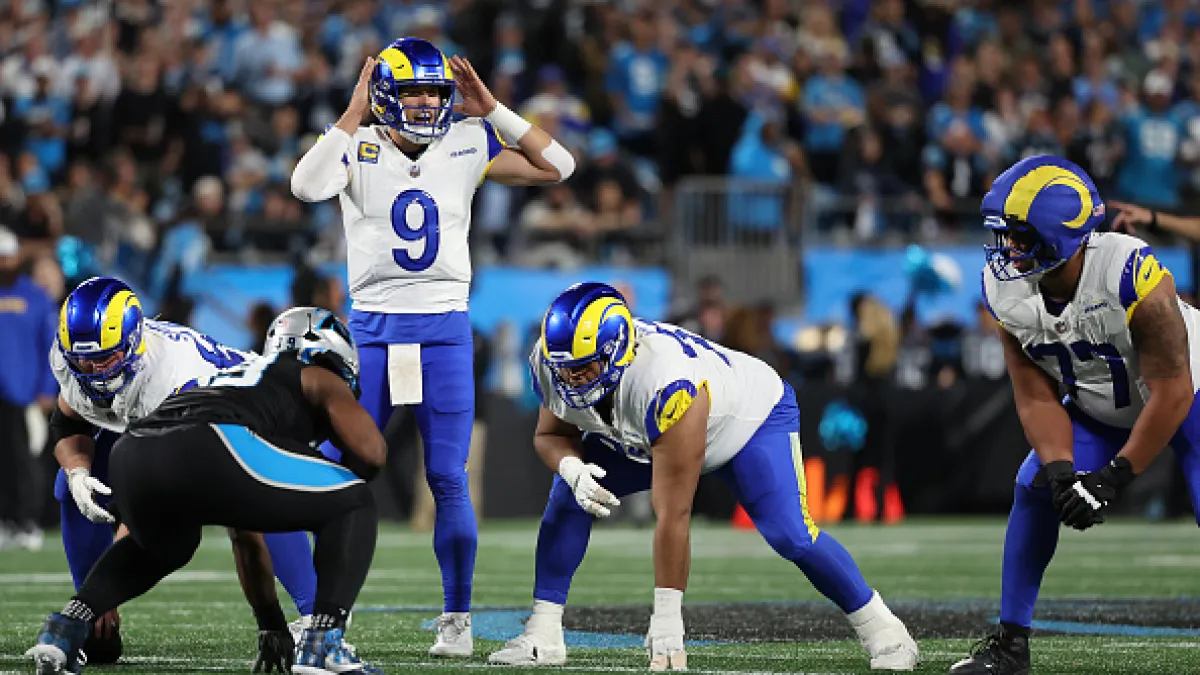

The sky over Charlotte hung heavy and gray on Saturday afternoon, the kind of muted Carolina backdrop that had already swallowed the Los Angeles Rams once before this season. Same field. Same weather. Same uneasy memory.
Only this time, the Rams refused to let history finish the sentence.
In a game that bent, twisted, and threatened to break them, the Rams survived a furious Carolina Panthers rally and escaped Bank of America Stadium with a heart-pounding 34–31 victory in the NFC Wild Card round — a win that felt less like a coronation and more like a trial by fire.
Los Angeles arrived as double-digit favorites, armed with the league’s most explosive offense and an MVP-caliber quarterback in Matthew Stafford. And for a brief stretch, it looked exactly like the mismatch everyone predicted.
Stafford wasted no time reminding the Panthers who he was. On the Rams’ opening drive, he stood tall in the pocket and fired a strike down the seam to Puka Nacua, who slipped between defenders for a 14-yard touchdown that quieted the crowd and put Los Angeles up 7–0. It felt routine. Clinical. Inevitable.
After a Carolina punt, Nacua struck again — this time as a runner. The rookie wide receiver took a handoff near the goal line and muscled his way in from five yards out early in the second quarter, pushing the Rams ahead 14–0 and forcing the Panthers to confront a familiar nightmare.
But Carolina never blinked.
The Panthers, who stunned the Rams here back in the regular season, answered with a drive that reintroduced belief to the building. Bryce Young guided a seven-play, 65-yard march, capped by a Chuba Hubbard one-yard touchdown plunge that cut the deficit in half and reignited a restless crowd that had seen this movie before.
Los Angeles regained control with a field goal to go up 17–7, but the game tilted sharply just before halftime — on a decision that will live in Sean McVay’s postseason ledger forever.
After a muffed punt by Carolina, and facing fourth-and-three in the red zone, McVay bypassed the safe points and went for the jugular. Stafford’s pass toward Tyler Higbee fell incomplete. Turnover on downs. Momentum gone.
“I’ll look at myself and say I wish I did a better job of putting our guys in a more advantageous spot. I’ll be kicking myself for that [decision],” said McVay. “Hopefully, I don’t make those same mistakes next wekk.”
Carolina seized it instantly.
With 1:31 remaining, Young attacked a vulnerable Rams secondary, and when the pocket collapsed near the red zone, he took matters into his own hands. The second-year quarterback sliced through defenders on a 16-yard scramble, juking Rams helmets like a joystick in an old arcade cabinet before diving into the end zone.
What should have been a comfortable 13-point halftime lead for Los Angeles dissolved into a tense 17–14 edge. The stadium buzzed. The Rams tightened.
And when the second half began, the unease turned real.
Carolina’s defense forced a three-and-out on the Rams’ opening possession, then marched just far enough to tie the game with a field goal. Suddenly, it was 17–17. A game that once felt scripted had become a coin flip.
Moments later, with the Rams up 20-17 and a chance to put the game out of reach, Stafford forced a throw. Interception.
The Panthers cashed in, leaning again on Hubbard, who powered in from a yard out for his second rushing touchdown of the afternoon. Just like that, Carolina had its first lead, 24–20, early in the fourth quarter — and the ghosts of the regular-season collapse hovered thick in the air.
Then came the play that saved the Rams’ season.
On the ensuing drive, former Rams safety Nick Scott appeared to have sealed the upset, intercepting Stafford in the end zone. But before Scott could complete the catch, Puka Nacua — receiver turned defender — ripped the ball loose as they fell to the turf. Incomplete. Drive alive.
“That pass break up was unbelievable,” said McVay of Nacua’s game-saving play. “He’s a freaking warrior. That’s what great players do. I’m glad he’s on our squad.”
Stafford didn’t waste the gift.
Two plays later, he floated a screen pass to Kyren Williams, who weaved through traffic and into the end zone for a 13-yard touchdown that swung the lead back to Los Angeles, 27–24, with 8:47 remaining.
Still, the Rams couldn’t escape themselves.
Special teams — their season-long kryptonite — reemerged at the worst possible moment. On a fourth-and-six from their own 42, the Rams’ punt was blocked, handing Carolina prime field position.
Four plays later, Bryce Young lofted a seven-yard touchdown to Jalen Coker in the corner of the end zone.
Panthers up 31–27. Just over two minutes left. Season on the brink.
That’s when Matthew Stafford became Matthew Stafford.
The same field where he fumbled away a potential game-winning drive months earlier now served as his stage for redemption. Calm. Commanding. Relentless. Stafford led a seven-play, 71-yard march that felt inevitable with every snap.
The drive ended with a moment of quiet brilliance — a 19-yard strike to tight end Colby Parkinson, who slipped inside the pylon with toes and ball barely breaking the plane. Touchdown. Rams lead, 34–31. Thirty-eight seconds left.
This time, the defense finished the job.
Carolina’s final drive sputtered under pressure, and the Rams forced a turnover on downs on fourth-and-ten, sealing a win that demanded every ounce of resolve they had.
It wasn’t pretty. It wasn’t clean. It wasn’t easy.
But it was real.
The Rams advance to the NFC Divisional Round for the second straight season, not because they dominated — but because they survived. Because their quarterback stood tallest when the ground shook hardest. Because their rookie star refused to let a season die in his hands.
Charlotte tried to swallow them again.
This time, the Rams pushed back.
About the Author