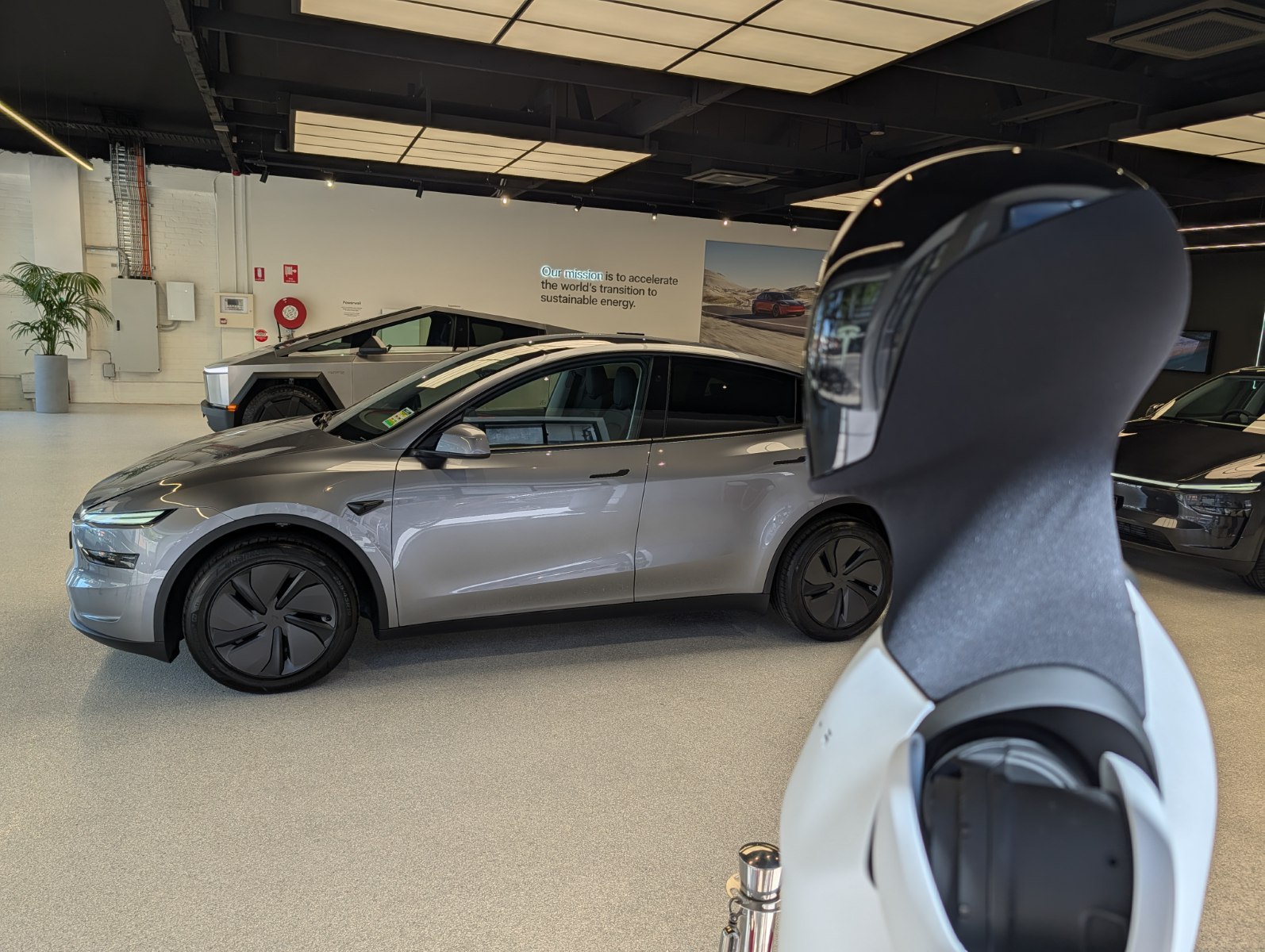
I recently spent some time at the Tesla store in Adelaide, one of the most recent additions to the local lineup. The showroom is currently playing host to a serious line-up of tech, including the new Model 3, Model Y, Powerwall 3, and the crowd-favourite Cybertruck.
But the real star of the show for me was the Optimus humanoid robot, which is making one of its first public appearances on Australian soil.

Meeting Optimus in the flesh
This was my first time seeing Tesla’s Optimus robot in person, and the level of detail is frankly staggering when you are standing right in front of it.
The unit on display is the Generation 2 model, which won’t actually be the one that hits the production line; that honour is reserved for Version 3.
Even so, seeing the Gen 2 up close gives you a massive appreciation for the engineering hurdles Tesla has already cleared.
The display stand is designed for show, but if you look closely at the back of the robot, you can see the small lip where the charging interface connects.
One thing that immediately caught me off guard was the height, as Optimus is significantly taller than I had imagined from watching the keynote videos.
Tesla has previously promoted the bot as being capable but not large enough to cause serious damage if it were to accidentally fall on a person.
In reality, it stands at 173cm tall, and while I have a fair bit of height on it at 192cm, it still feels like a very substantial presence in the room.

Friendly design meets serious engineering
Even though the robot was in a disabled state for the display, it doesn’t feel cold or industrial like the robots you see in car manufacturing plants.
The glossy faceplate and the fabric-covered shoulders give it a surprisingly comfortable and friendly aesthetic that wouldn’t feel out of place in a home.
When you look at the arms and legs, the integration of the actuators is seriously impressive, mimicking the human form factor with incredible precision.
It is easy to look at this and see a path where these robots become as common as the car in your driveway or the phone in your pocket.
The opportunity for a device like this to change the way we handle mundane tasks at work and at home is absolutely massive.
“I think Optimus will be more valuable than everything else combined. If you have a humanoid robot that is capable of doing anything you can do, there is no limit to the size of the economy.”
Elon Musk, CEO, Tesla.

Cybertruck and the Tesla ecosystem
While Optimus took most of my attention, the Cybertruck continues to be a massive drawcard for the Adelaide store and for good reason.
This is one of the only places in Australia where you can actually get hands-on with the stainless steel beast and see its scale for yourself.
It isn’t officially available for purchase in Australia just yet, but having it here provides a rare preview of what our future road landscape might look like.
Love it or hate it, the design is unlike anything else on the road, and the build quality of the display units feels incredibly robust.
The sheer presence of the vehicle in the showroom is a testament to Tesla’s willingness to throw out the traditional automotive rulebook.

Powerwall 3 and the home battery revolution
Moving over to the energy side of the business, the Powerwall 3 was also on display, representing the latest in home energy storage technology.
The Powerwall 3 is now available in Australia, featuring an integrated solar inverter which makes for a much cleaner and more efficient installation.
Pricing for the Powerwall 3 in Australia starts at approximately A$11,900 for the hardware, though the total cost including the Gateway and installation typically lands around A$18,000.
“The Cheaper Home Batteries Program has been an unprecedented success. The program has brought down the cost of installing a solar connected battery.”
Chris Bowen, Minister for Climate Change and Energy, Australian Government.
The success of home storage in Australia has been nothing short of explosive since the introduction of the Cheaper Home Batteries Program last year.
The original A$2.3 billion budget was so popular that the government recently had to expand the funding to A$7.2 billion to keep up with demand.
In the second half of 2025 alone, over 184,000 batteries were installed across the country, adding a massive 4.27 GWh of storage to the national grid. A massive shift is happening right now, as the federal rebate transitions to a tiered system from 1 May 2026 to encourage right-sized battery installations.
Under the current rules until April, you can still grab roughly A$336 per kWh of usable capacity, which is a significant chunk of change for early adopters. The focus for many Australians has shifted from simply saving money on bills to achieving genuine energy independence as feed-in tariffs continue to drop.

The current Australian line-up
Of course, the showroom still features the heavy hitters that you can actually drive home today, specifically the Model 3 and the Model Y.
The Model 3 Highland refresh remains a benchmark for electric sedans, starting at A$54,900 plus on-road costs for the Rear-Wheel Drive variant.
If you need more space, the Model Y is still the king of the electric SUV segment in Australia, starting from A$58,900 plus on-roads.
Tesla has also recently moved to a five-year, unlimited-kilometre warranty for all new vehicles delivered in Australia from the start of 2026.
This is a welcome move for the local market and brings them in line with many of the legacy manufacturers offering similar peace of mind.
Spending time at the Adelaide store makes it clear that Tesla is no longer just a car company, but a full-scale robotics and energy firm.
Seeing these technologies co-existing in one space makes the transition to a sustainable, automated future feel a lot closer than it did yesterday.
For more information, head to https://www.tesla.com/en_au
Referral: If you want to support techAU and are buying a Tesla, please use the following link – https://ts.la/jason45054
About the Author