
Film Name: Antebody
Director: James P. Gleason
Writer: James P. Gleason
Starring: Henry LeBlanc, Kristin Carey, Herb Mendelsohn, Pierre Stahre, John Steven Rocha
The police may know how Marty died, Lois may know how Marty lived, but there’s something you don’t know about Martin David Ambro…?
In a new exclusive interview on Blazing Minds, I got a chance to ask Writer-Director James P. Gleason a few questions about the film ‘Antebody’, which has been selected to play at Horror-on-Sea on Saturday 24th January at 15:00hrs.
Q. Your film Antebody has been selected to play at the Horror-on-Sea Film Festival. Can you tell us what we can expect?
A. Let’s say it’s like a CSI episode that fell off the tracks. Do you guys get CSI over here?
Q. What were your inspirations when writing the script?
A. Funny you should ask. There were TWO very specific sparks to get this story started:
FIRST – we have to go back to when this thing was made: Dreamt up in early 2001. There was a popular show on HBO back then called Autopsy, hosted by Michael M Baden – a forensic pathologist who was known for some high-profile
SECOND – I used to work in an office that backed on the Los Angeles River up in the Valley. River? HA! It was a concrete channel with vertical walls with nothing more than a trickle in a narrower channel running down the middle. You call that a river? I was told by co-workers to wait until it rained. The water level will come up. First come the McDonald land balls (McDonald’s up the street had a children’s playland inside that included a ball crawl – and kids (mostly teens) would throw those colourful plastic balls into the channel, where they would just sit on the concrete until the rains washed them down river. Then would come the branches. Furniture that had been discarded in the channel. Etc. Seriously? Yeah, sure!
WELL – sure enough, when rains came that winter, here came the McDonaldland balls. The water level rose so it was no longer just in the centre channel, it was now flowing across the entire width of the outer channel. Here came branches, huge limbs, entire trees. And couches and other such furniture. The water rose higher and higher. Oh, my God! The level kept rising. What happens if the water level goes higher than the channel? What if someone fell in there? How would they ever get out? They’d be swept down the channel. There was a set of vertical rungs on the far side of the channel, but someone would have to be near the edge to even have a prayer of grabbing onto a rung, but the speed of the water would probably rip them away again! Someone could fall in way up here in the Valley and who knows where they’d wash up? Downtown? Or would they keep on going? All the way down to the ocean? If a body was found, how would anyone ever know where it went in? How would detectives ever figure out what happened at the place they went in if they don’t even know where they went in?
A week later, after seeing that terrifying torrent in the channel, and after having seen the latest
episode of HBO’s “Autopsy” – the concept for ANTEBODY was born! I was pitching it as the
concept for my USC thesis film within the week!
Q. Did you have any of the cast in mind for the characters when writing the script?
A. Nope. Not a one! My casting director, Michael Donovan, brought me a wonderful array of candidates!
Q. What were some of your influences for the look and style of the film?
A. Nick Saglimbeni (my cinematographer) and I were both fans of Seven (1995) (gorgeous and dreary at
the same time). MY favourite movie (then and now) is Twelve Monkeys (1995) (between Roger Pratt’s Cinematography and Jeffrey Beecroft’s Production Design – it’s exquisitely textured). With those two movies in mind (not to mention every movie I’ve ever seen), I knew the look I was after!
Q. In addition to writing and directing, what else did you do on this film?
A. I went in expecting just to write and direct it, but since financing was coming from my friends and family (like all student films) and I needed to figure out how to stretch those funds out, that made me a producer too. And after two other editors worked on it (the first got his own thesis film, the other one went on to other things), I wound up finishing up the cut myself, and I had no idea how much post-production work was involved beyond our colour session and sound design and mix.
Though not credited that way, I now know that doing all that makes you a Post-Production Supervisor. Yeah, I did all that stuff, down to getting all the distribution media done (VHS’s and DVD’s and related packaging, 35mm prints), DVD menus (designing those was fun but slow work), posters, postcards, a website, all the marketing stuff took forever! We don’t learn that in film school, we stumble into it trying to get to the finish line.
Q. Did you make any changes from the original script during filming?
A. During filming? Only one thing – we had to completely rework the railroad bridge scene (more on this on the next question). During editing? Really only one thing – the leads are a couple with kids. We had a scene with one of the kids interrupting in the background, but it didn’t work, so the poor kid wound up on the cutting room floor.
During rehearsal? (OK, so now we’re back to before filming) While rehearsing the Morgue Scene, I realized that I had forgotten to include some vital information. I don’t want to give away any spoilers here, but this subtle yet critical information had to come out, and I had forgotten to write it into the script.
I realized that my answer was write there (see what I did there?) in front of me! My characters were right there – by this time, the actors would know their characters better than I do! Why not have them bring out the information? I told them what needed to come out, and during the next run-through, my characters (as manifested by the actors) told me the information in a way that was natural to them – I wrote it into the script that way, and by the time we got to the Morgue set on shooting day, it was on the page and everybody was literally on the same page.
Q. What were some of your favourite moments during filming?
A. I know I said I’d answer the last question here, but my favourite moments were in the middle of a set of issue we encountered while filming at the railroad bridge, so – read about it at the NEXT question!
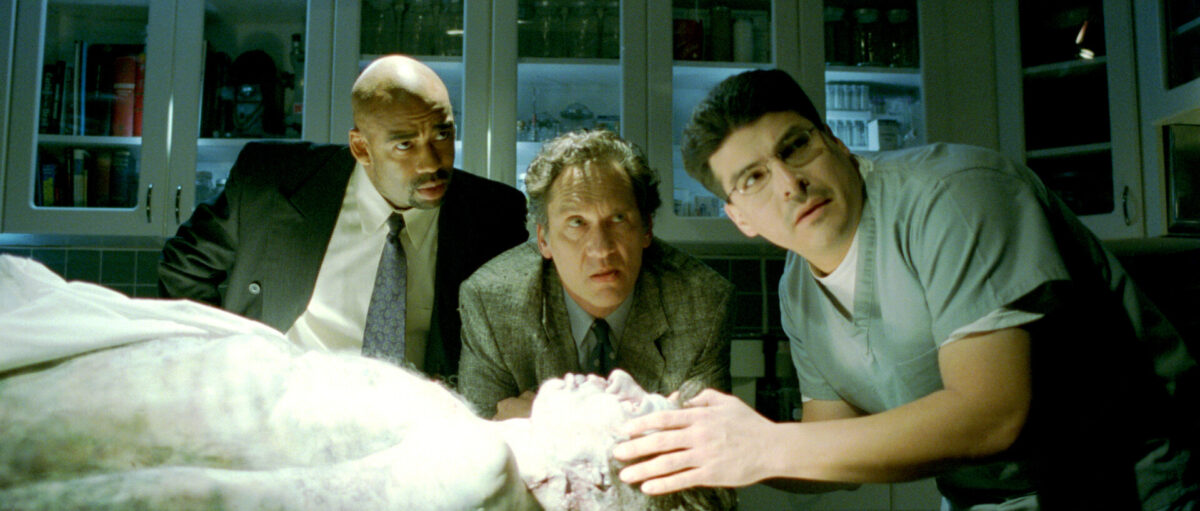
My OTHER favourite moment was on Morgue Scene day seeing the first run-through of the coroner presenting the corpse on a slab to our leading couple as the detectives looked on. That set was perfect. The body was perfect. The lighting was perfect. The cast was perfect. This was going to be perfect!
Q. Did you experience any issues during filming?
A. The day we shot our infamous railroad bridge, everything went to Hell, but it’s still a spectacular scene.
We were originally planning to shoot the kids playing a game on the railroad bridge, dropping rocks and things down through the grate – trying to hit trash floating by in the river below. They’d be horrified when a body floated beneath them! This is a bad idea for so many reasons (ten years later, Sarah Jones, 2AC, was killed on a railroad bridge during filming – OMG, I could have something like that on my conscience)!
We scouted the location, got all the permits except the railroad bridge (they wouldn’t grant it), so we came up with our own safety plan: We would station lookouts with radios a half mile and a mile out in each direction who would have to confirm that it was safe every 15 seconds or we’d clear the bridge – it wasn’t enough to warn of danger, what if the warning didn’t come through? You had to confirm it was safe or we’d clear the bridge. A radio failure using this method wouldn’t leave us exposed, we’d get off the bridge.
So why didn’t we deploy our plan? WELL – I had one crew when we scouted the location in December, but we didn’t shoot until January (the next semester) and I had some turnover in the crew. My new AD and one of my producers protested (the producer actually quit that day), even though our studio teacher approved it as a safe plan.
But I realized we may have a problem. USC had a safety rule. Unsafe footage could NOT be included in a film. If this many people were protesting, I’d likely have a problem with the safety review. Why shoot it if we can’t use it?
We had an 80’ crane donated by Panavision (I DID have to pay for the operators, one of them had to be flown down from Oregon (also on my dime)). Our plan had been to set up the crane just off the bridge, pointing the camera at stand-ins on the bridge while we framed up, get the kids in – get the shot, get them out, prep the next shot. Nick had storyboarded the hell out of that scene. But now? Out the window!
I decided to have the kids play on opposite sides of the river, throwing stuff into the middle at garbage floating by, the shock would come when the body floated in between them! We had the crane. Wasted? Not at all! We’d swing it out over the river and shoot each direction at the kids on each side.
Trains came by. We realized we could use the crane to sweep down from a passing train on the bridge to the kids playing at the river. Great! Except the first time we tried it (a train only came by once an hour or so), we swept down to the river – the kids were gone! Dammit! The next time we tried it, one of the kids had substituted a friend while they went off to the bathroom. Dammit! The time after that, it was all beautiful, but the kid on the near side turned around toward the camera asking what they were supposed to do? ARGH!! Dammit! The time after that, we finally got it! It’s the opening shot of the movie.
We did not actually kill and float our lead actor down the river. Tommy Mounkes created a replica corpse of our lead body (which we had used the weekend before in our Morgue Scene). We called it “Bob.” Why? My old boss from my last job before film school donated $3000 to buy the film stock. He loved the idea of buying the film itself. I told him that we instead used that money to pay for the body. We named it after him (Bob Gallagher, Jr), we called it “Bob!” We pronounced it “Bawb,” but spelled it “Bob.” I even filled out an actor’s waiver and medical release for Bob, using my storage unit as Bob’s address. But I digress.
SO – on the day at the railroad bridge, we were going to trash Bob by putting him in the filthy Los Angeles River. But he floated like a cork! Bodies are buoyant, but not THAT buoyant! He was spongy (foam rubber and wire coated in latex). So we had to squeeze the air out of him and let him soak up enough water where he floated like a real body (call it a Pinocchio complex).
Some directors don’t care, but I personally don’t like to traumatize children into years and years of therapy. I didn’t want to freak them out with the body, wanting instead to make it clear to them that Bob was (for all practical purposes), a huge, lifelike stuffed toy! So I let the kids help me squish Bob under water.
As luck would have it, a family walked by on the shore, and upon encountering two adults and two children holding a naked man’s body (with a plastic bag over its head) underwater, they left in a hurry. It was no surprise when police arrived ten minutes later. I’m so glad we had a permit. We didn’t want anybody to actually have to go IN to the river water, it’s pretty gross. We rigged Bob with fishline so he could pass through the shot, then we could pull him back up … except … the fishline broke the surface of the water on every take and it was obvious Bob was on a line. We’d have to float him WITHOUT a line and have people in the water to retrieve him!
Moe Moe Lwin, our Production Designer, had rubber boots, but they were only about 10” high (if that). She wasn’t expecting to get in the water, but she expected that we’d be splashing water up onto the embankment. She went into the channel at times – but the water was a few inches higher than her boots. She’d come out of the channel, take off her boots and empty them every time.
We designed a shot where we’d have Bob float directly under the camera (using the crane, positioning the camera over the centre of the channel), and as he floated floated away, we’d raise the crane up behind the bridge, viewing his murdered corpse as he floated away off into the distance through the lattice work of the bridge. We didn’t want any people in the shot, but conveniently, there was another bridge about a half mile away. That meant we’d have to stage a few guys (sorry, art department and grips!) down at that other bridge, out of view, to pop out when we yelled “Cut” to catch the body. If they missed, Bob would have floated all the way down to the ocean where he would have torpedoed and sunk the Queen Mary docked in Long Beach, and who wanted that to happen?
Those four sad and soggy souls are credited as the “Bob Swim Team” (watch for it in the credits) So we had started out with one plan, threw it out the window. Made up a whole different version on the spot. I had four soaked crew members (in filthy river water), my cinematographer stomping around like Rumpelstiltskin, screaming that this was his worst day ever on set …
… and I was having my best day ever, realizing that though I didn’t get what I wanted, I got what I needed. That was the day that I realized I could make it in this business. (It reminded me of Wag the Dog (1997) where Dustin Hoffman played Hollywood producer Stanley Motts, hired by the president to fake a war to distract the media from a sex scandal. Every time the plan started to fall apart, Motts would say “this reminds me of the time when…” and he’d describe a ridiculous on-set disaster that he turned into Hollywood gold).
Q. What makes Antebody stand out as something different in the horror genre?
A. It’s goofy as hell, if you think about it. I wrote it as a drama, directed it as a comedy, but it has horrific elements. It’s a certification of why I should be certified. The worst horror of the entire movie isn’t what you see, it’s what’s going to happen to our lead after the credits roll – and there’s nothing anybody can do to stop it!
Q. What do you hope people take away after watching the film?
A. I want to thrash the audience back and forth. Do we have any control over our destiny? I lead you one way, then I toss you the other. At the end, I throw up my hands – You decide!
Most people just let go at the end like they’ve finished an amusement park ride, but what I’d really like is for them to contemplate the implications of what the last scene means! Oh, God! How awful! But nobody ever seems to go there! I find that kind of fascinating.
Q. Do you have any other projects which you are currently working on?
A. Oh, God! What am I not working on?
I’m trying to decide if I should go ahead and shoot the next two shorts I have in pre-production (out of my stack of about 10 ready to go!) or just skip ahead to a feature. I’ve been told a few times that I’m ready for a feature, but might those two shorts be strategic tools to assist me in funding a feature? There are duelling schools of thought on that topic, but there are no guaranteed formulas for success.
One of those two shorts would be about 90 seconds, the other about ten minutes (my two completed shorts to date are each over 15 minutes). I’ve got a few features written, but they’re not ready to go, and I have three new scripts in various stages of gestation (more like embryos end than fetuses end). Maybe I should shoot those two shorts and get them out there while working on funding for a feature? Maybe? Hmm. Stay tuned!
Q. If someone was looking to write and direct their own film what advice would you give them?
A. Don’t do it like me. I come up with crazy complicated concepts and then try to figure out how to pursue the resources to make them happen, and that’s not terribly cost effective (danged expensive, actually). And I also have the misfortune of having had my best experiences with bigger crews. So I tend to want to shoot with a bigger crew, which is also stupid expensive. The smart thing to do is come up with stories that take advantage of resources readily at your disposal. There are some incredibly good shorts out there made incredibly cheap, using locations that are free and available, using props that already belong to you and/or friends and family, and shoot simply. A good story is more important than fancy production values. A good story with poor production values will still generate buzz. But high production values without a good story are seen as a waste – why spend the money? One of my friends shoots by himself (no crew), gets his locations for free (well, he shoots and edits a promo for them which they can use on social media – in exchange for using the locations in his films – is that really “free”?), and he shoots So cheaply that he can defer paying his actors (they only get paid if the short makes money, and what short makes money??) Shoot with friends and family when you can! Unless they’re jerks (if they’re jerks, why are they your friends then?), they won’t charge you. I wish I would listen to my own advice.
‘Antebody’ has been selected to play at Horror-on-Sea on Saturday 24th January at 15:00hrs.
You can find out more about Horror-on-Sea and purchase tickets for Antebody here

Published in various websites, Philip is a reviewer who is best known for his interviews and media coverage of independent projects including; films, books, theatre and live events. Always on the lookout for something different to cover!
About the Author


