The Antigravity A1 was recently released and offers an innovative new approach to drones. This is the world’s first 8K 360 drone, which doesn’t just capture the world from above, it records the entire environment around it.
The drone merges the footage from two cameras positioned at the front of the drone to create the 360 degree frames. As is the case with 360 cameras used on the ground, this provides the creative freedom to play director and change the framing of the video in post-production. The other option is to upload the full 360 footage to platforms that support it (i.e. YouTube) and let the audience control the camera for themselves.
Anytime you take the pixels and map them to a 360 virtual space, you need lots of pixels to avoid having them stretch, which degrades the quality. Thankfully, the Antigravity A1 can record in 8K quality, which allows you to zoom in on content while editing and still get a great outcome.
Given that many of our video platforms require common aspect ratios like 16:9 or vertical 9:16, you just import the footage into the Antigravity Studio app and make your edits before exporting to match what you need. The desktop app is impressively featured for the launch of a new product like this and has seen a number of updates already since I first got hold of it, showing an ongoing commitment to improve over time.
This drone is explicitly aimed at creative explorers, travel vloggers, immersive media enthusiasts, and filmmakers looking to capture those 1-shot scenes with a level of redundancy. Crucially, the A1’s sub-249g weight class offers a huge advantage, allowing recreational pilots to bypass many of the regulatory hurdles associated with heavier drones, making it the ideal companion for capturing adventures across the country, from the coastline to the outback.

Design
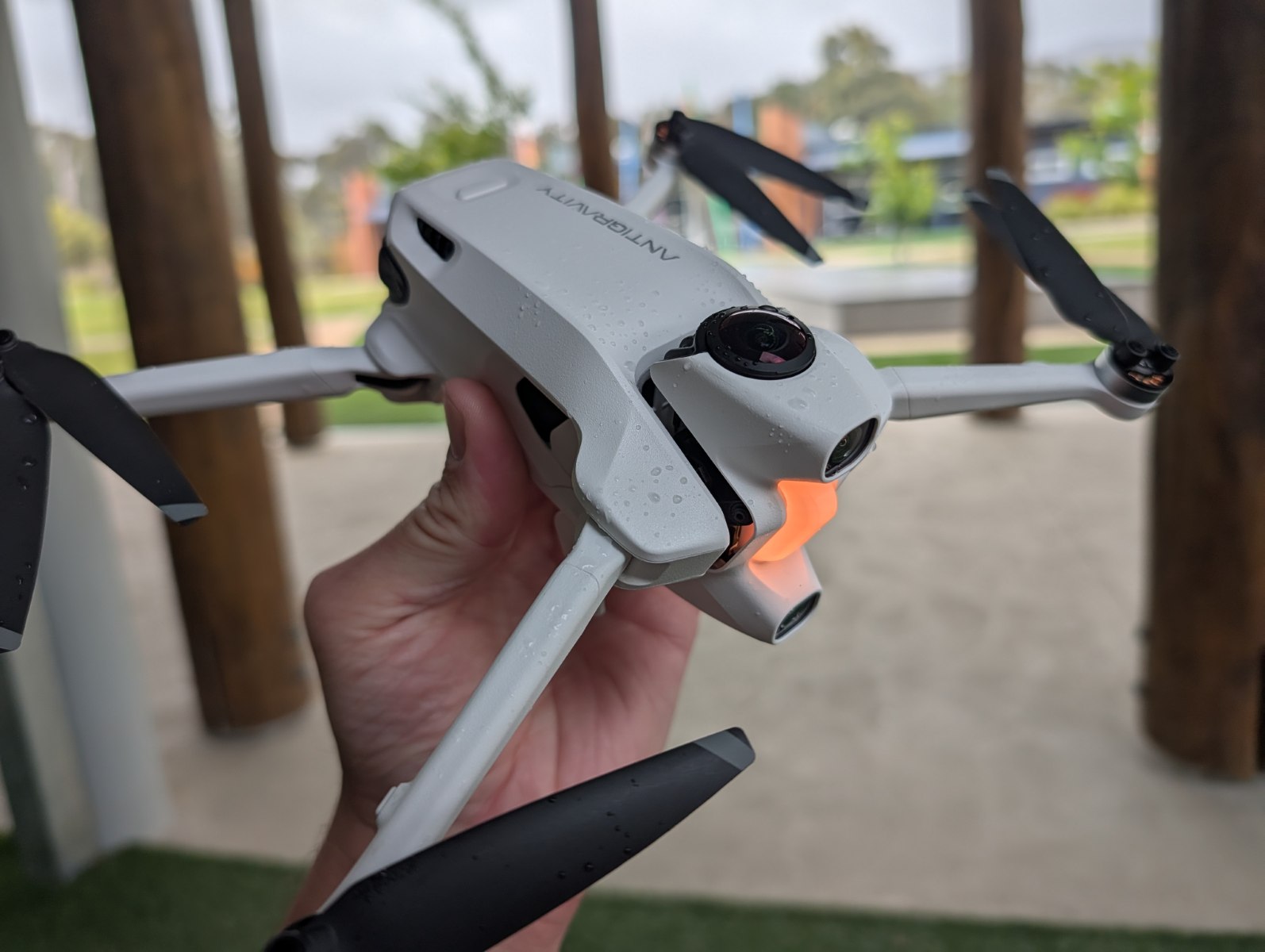
The A1’s design is a blends form and function, driven by the goal of making the drone invisible in its own footage. The device is compact and lightweight, impressively adding the dual-lens system and landing legs without adding bulk. The foldable design makes it highly portable, easily slipping into a backpack or camera bag without fuss.
The most innovative design attribute is the camera system itself, which features two precisely positioned fisheye lenses. These lenses, combined with advanced stitching algorithms, create the “360 Vanishing Act,” ensuring the drone itself, its arms, and its propellers disappear completely from the final 360 sphere. This solves a perennial problem for action camera users and gives the footage a clean, untethered perspective that rivals shots captured by much larger, more expensive rigs.
Naturally, with any camera, you want to be protective of the lens, but this is particularly the case with a 360 camera; any scratch will effectively render the footage unusable. To guard against this, Antigravity leverages mechanically driven landing legs on the front, which provide just enough clearance to ensure the lens doesn’t touch the ground. This does require a flag landing surface, so you should be careful on uneven surfaces.
I did notice some difficulty putting the drone back into its case; there’s virtually no tolerance, so having the legs down means the case won’t close. Thankfully, it’s pretty easy to understand why and manually fold the legs. Given the sensitivity around the lenses, you can’t simply throw this on your front seat to travel between destinations; you really need to be diligent about packing it away properly.
While the design sacrifices a traditional mechanical gimbal, which some filmmakers might miss for dedicated framed shots, this is a conscious trade-off that works brilliantly for the target audience.
Along with the drone, there are a couple of other key components to this setup, including the goggles and controller. The goggles are comfortable and carry the unique attribute of a display on the outside, allowing people around you to know what you’re looking at. This is a great inclusion, one I never really thought was needed, until I used it.
The controller is a handheld, motion controller with lots of buttons and dials. At first, it’s somewhere between being too easy and too difficult, so you do need to spend time with it to fully get your head around it, remembering you’ll not be able to see it once you are flying.
The controller works with an on-screen virtual UI that overlays the footage from the drone’s cameras. This is selectable using the remote, very similar to how VR headsets and controllers work.

Performance
The core performance of the Antigravity A1 hinges on its 8K 360 capture capabilities. This is a staggering amount of data, granting “full-sky memory” and allowing users to pull crystal-clear, high-resolution 4K reframed video from any angle within the original sphere. The clarity and flexibility this offers in post-production are substantial, ensuring that detail is retained whether you are exporting a wide landscape shot or a close-up tracking movement.
Flight performance is powered by something called FreeMotion technology and the use of the Grip controller. For beginners, the learning curve is very approachable, with the Grip acting like a ‘magic wand’ or an aerial pointer, allowing pilots to steer the drone with simple, arm-swinging gestures instead of complicated dual-stick inputs. This intuitive motion control facilitates pure flight joy, making advanced aerial maneuvers like orbit shots or side-flying accessible to anyone.
In FreeMotion Mode, the drone is steered with its nose forward in the direction of travel. This ensures the forward-facing obstacle avoidance sensors are optimally positioned to detect and handle hazards. Coupled with return-to-home functionality and a compliance-focused payload detection system, the A1 provides a high degree of confidence for pilots, letting them focus on creativity rather than control complexity.

Features
The Antigravity A1 is packed with features that distinguish it from standard camera drones, centring the user experience on creative freedom and flight immersion.
Invisible Drone
An advanced 360 image-stitching algorithm, powered by Insta360, makes the drone completely vanish from the captured footage, allowing for clean, unobstructed aerial views.
8K 360 Video Capture
The drone records the entire scene around it in 8K resolution, giving users the flexibility to extract any angle, viewpoint, or aspect ratio in 4K clarity after the flight is complete.
Sub-249g Regulatory Compliance
The lightweight design ensures the A1 falls into the highly desirable sub-250 gram category in most regions, including Australia, which significantly reduces registration and regulatory requirements for recreational users.
Intuitive Motion Control with Grip
The included Grip controller allows pilots to guide the drone using simple, natural hand movements, making complex flying maneuvers intuitive and accessible to beginners.
Reframing
This post-production capability allows the pilot to choose their final perspective and dynamic camera movements after the footage has been captured, eliminating the stress of having to frame the perfect shot while flying.

Issues and Opportunities
While the Antigravity A1 is a game-changer, there are a few areas where future iterations could improve, primarily related to the overall cost of ownership. The core technology, the 8K 360 camera, is exceptional, but the complete immersive experience comes at a premium.
While the Grip controller is approachable, I’ve flown a lot over the years and as an experienced pilot, I love the control a standard dual-stick controller provides. Its possible Antigravity adds this in the future, but for now, the grip controller is the only option.
A second opportunity lies in the UI overlay and controller interaction. I noticed a couple of times it became very difficult to get the controller pointer to register with the UI. Ultimately, I was able to press the menu button, reorient the controller and get it sorted, but this experience was one that I’d like to see avoided. It reminded me of very early VR experiences, which were clunky, but when it does work is very natural.
Finally, an observation from using the pre-release software, the transmission between the goggles and the drone did experience slight delays, we’re talking sub-second, but that did impact my confidence level when flying close to objects. Thankfully, this improved in subsequent firmware updates.
Hands-on video
The following video was shot on the Antigravity A1 drone and edited using the Antigravity Studio software. In the video, the direction of the video is changed during the editing process, something not possible with any other drone I’ve used.
Price and Availability
The Antigravity A1 Drone is available now with the complete package, including the Antigravity A1 Drone, one Intelligent Flight Battery, the Grip Controller, and Vision Goggles, which costs A$2,199.
An Explorer Bundle costs A$2,799, and for the extra money, you get a carry bag (which is excellent by the way), a charging hub and 3 batteries instead of 1.
Finally, there’s the Infiniti Bundle at A$2,899. This includes 1× A1 Drone, 1× Vision Goggles, 1× Grip Controller, 3× High-capacity Flight Battery, 1× Quick Reader, 1× Charging Hub, 1× A1 Drone Carry Case, 1× Sling Bag, 8× Spare Propellers.
If you’re a newer pilot, consider the pop guard accessory for A$49.99.
You can get these from the Antigravity website – https://www.antigravity.tech/us/drone/antigravity-a1/buy.

Overall
The Antigravity A1 Drone is a genuine breath of fresh air in a market dominated by iterative camera upgrades. It’s not just a drone, it’s a 360 camera with wings. The ability to capture the full 360-degree scene in stunning 8K, and the subsequent freedom to reframe the content later, transforms the aerial filming workflow and unlocks creative potential.
If you are a professional content creator, a dedicated travel vlogger, or an immersive media producer, the Antigravity A1 is absolutely worth the investment. It is purpose-built to give you high-quality, regulation-friendly footage that no other mini drone can currently deliver.
For the price tag, it’s a lot for the size of the drone, but the additional technology included helps justify the cost, as does the functionality you get.
The goggles offer great quality images when you’re flying and importantly, what you actually capture looks fantastic too.
This is a completely new, immersive experience and does a great job at eliminating the frustration of missed shots, the Antigravity A1 is worth consideration when shortlisting your next drone purchase.
For more details, visit www.antigravity.tech
About the Author