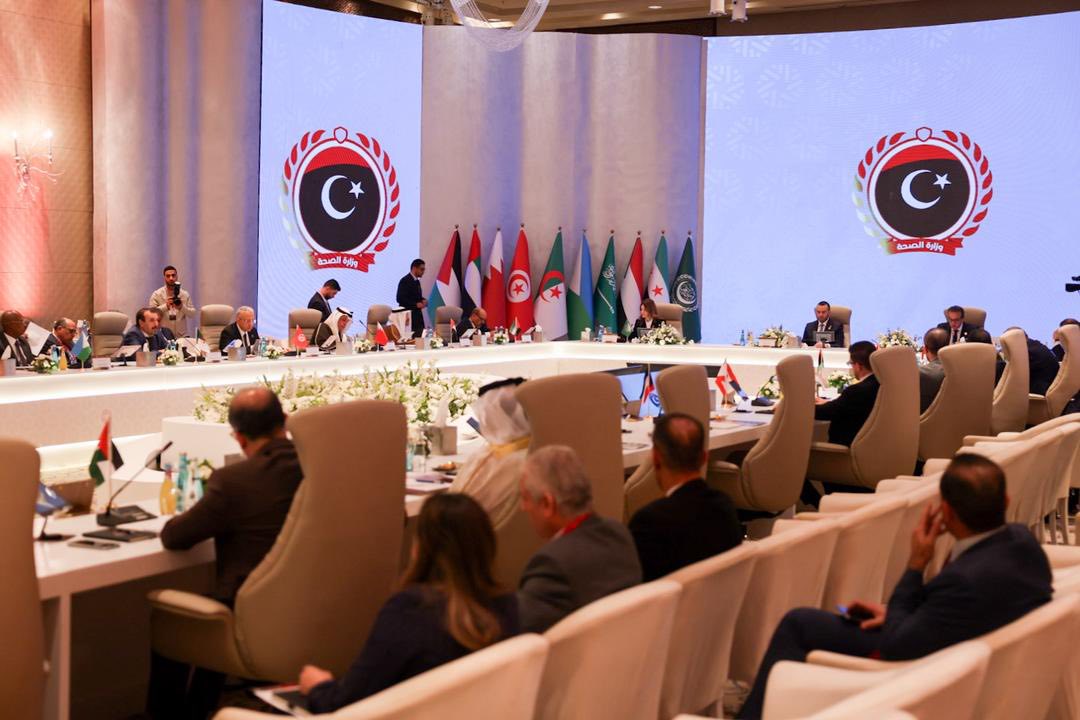
The Acting Minister of Health in the Government of National Unity, Mohamed Al-Ghouj, on Thursday inaugurated the 63rd ordinary session of the Arab Ministers of Health Council, hosted by the capital, Tripoli, with the participation of Arab health ministers, representatives of the General Secretariat of the Arab League, and a number of international health organizations and bodies.
The meeting was attended by Egyptian Deputy Prime Minister and Minister of Health and Population Khaled Abdel Ghaffar; Iraqi Minister of Health Saleh Al-Hasnawi; Tunisian Minister of Health Mostafa Al-Ferjani; Mauritanian Minister of Health Mohamed Mahmoud; Syrian Minister of Health Musab Al-Ali; Djiboutian Minister of Health Ahmed Abdallah; Sudanese Minister of Health Haitham Ibrahim; Yemeni Minister of Health Qassem Buhaybeh; as well as a delegation from the General Secretariat of the Arab League, in addition to senior health officials and representatives of member states.
The Libyan Ministry of Health said on its Facebook page that the meeting’s agenda included a presentation on the state of the health sector in Libya and efforts to develop it, alongside presentations of several successful Arab health experiences. These included Libya’s experience in developing health information systems, Egypt’s experience in eliminating hepatitis C virus (HCV), Tunisia’s experience in electronic vaccination, and Algeria’s experience in combating drug abuse.
The ministry noted that the session also witnessed the presentation of the 2025 Arab Physician Award in the fields of scientific research, innovation, professional excellence, medical leadership, and good governance in managing the quality of health systems.
It added that Al-Ghouj will hold a series of bilateral meetings on the sidelines of the session with health ministers from participating countries to discuss prospects for strengthening health partnerships, expanding areas of joint cooperation, and exchanging expertise on priority issues.
The ministry considered the convening of this session in Tripoli an important milestone in enhancing Arab health coordination and integration, exchanging expertise, and supporting joint efforts to address health challenges, contributing to the development of health systems and the achievement of collective Arab health security.
About the Author