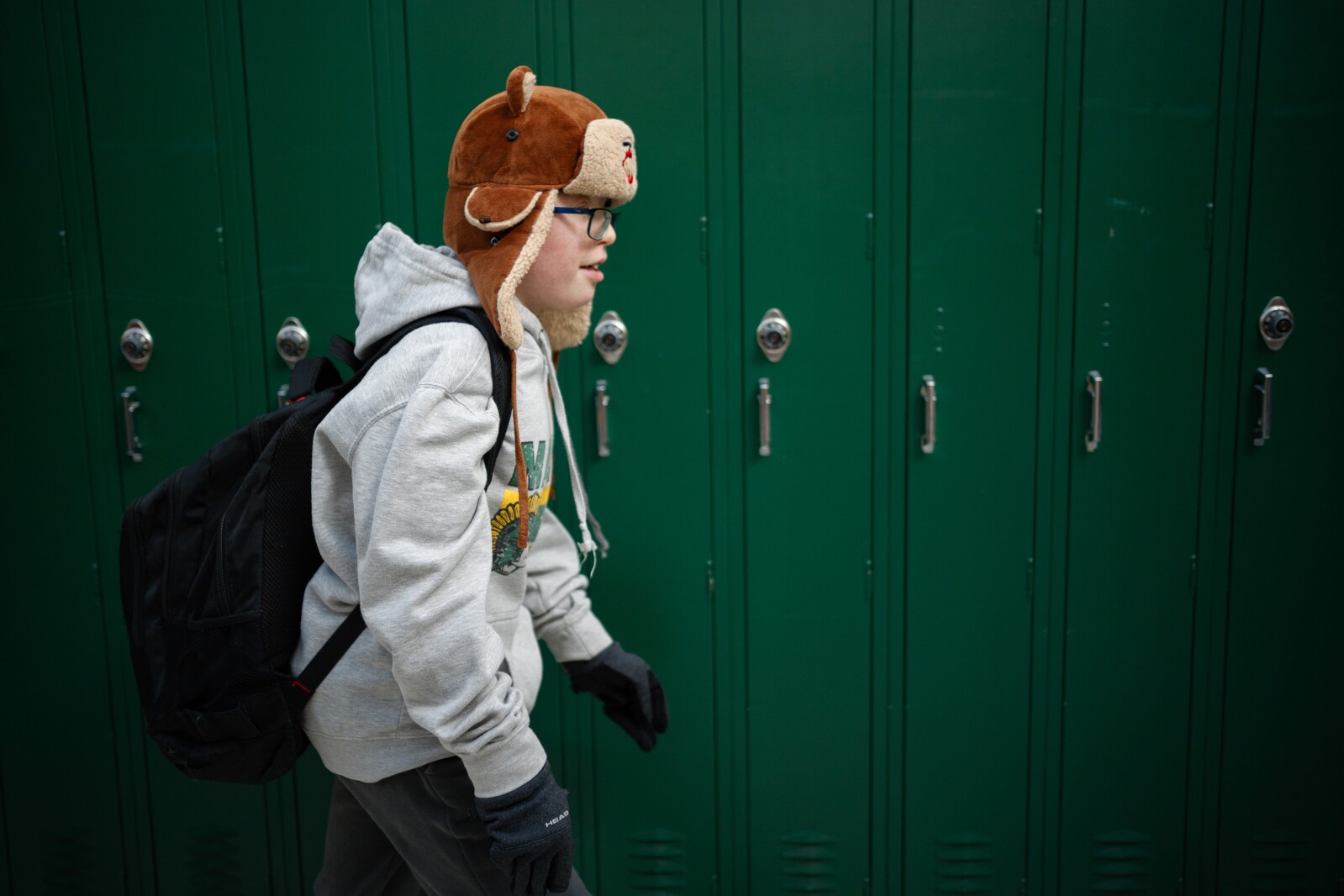
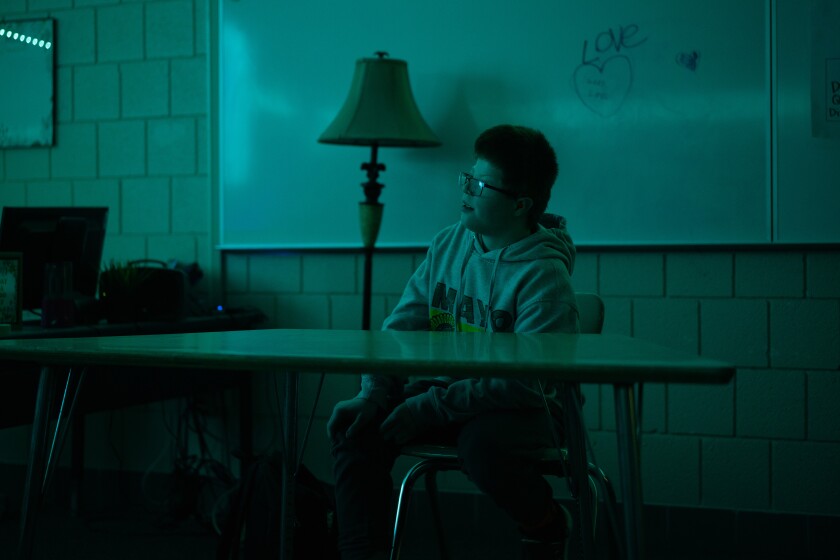
ROCHESTER — On the last day of school before Christmas break, Sawyer Hanson was walking through the halls of Mayo High School as a 16-year-old freshman with a full schedule. After finishing World History in the first hour with his general education classmates, he made his way into a special education class for “Social Strategies.”
Once everyone settled into their corner of the room, the teacher projected a grid of 12 iconic faces onto the whiteboard from different Christmas movies. There was Charlie Brown with a grin from ear to ear. Tim Allen was looking somewhat exasperated in a loose-fitting Santa suit. There were the beaming faces of the family at the end of “It’s A Wonderful Life.” And — controversially for a holiday montage — there was even the determined face of Bruce Willis in “Die Hard.”
The teacher asked each of the students what face they thought described them most for the day.
Special education classes like that give Sawyer, who was diagnosed with a genetic condition that left him with a hearing impairment and a cognitive delay, the extra resources he needs to thrive in a school environment.
But overall, his day doesn’t look too different from his general education classmates. He says hi to other students walking through the halls. He chats about his weekend with a friend over lunch. He competes in sports and went to the homecoming dance.
It’s a stark difference from what Sawyer’s day might have looked like 50 years ago at the dawn of what is now known as special education.
President Gerald Ford signed the “Education for All Handicapped Children Act” in November 1975. It set the stage for the network of support systems that eventually would be set in place to provide a school experience for those facing challenges. In 1990, it would become known as the Individuals with Disabilities Education Act (IDEA).
Today, it’s easy to take for granted that students with disabilities can attend school like anyone else their age — or that they can do so while getting the other supports they need.
In addition to attending special education classes, Sawyer also wears hearing aids and is part of the deaf and hard-of-hearing program at RPS. Among other things, that means that when he walks into a classroom, his hearing aids connect to a microphone worn around the teacher’s neck.
From the very beginning, there were a slew of people guiding his family through the process of what school and life would look like for him.
“From the moment Sawyer was born, people have had our backs,” his mother, Wendy Hanson, said. “They really set us up for success.”
Although Sawyer’s experience may be unique in a sense, he’s one of hundreds of students who now benefits from education reform introduced all those decades ago. In Rochester Public Schools, one in five students has an individualized education plan, which means they receive some form of special education.

Joe Ahlquist / Post Bulletin
For students like Sawyer, it means they go to school in one of the district’s mainstream schools. But his story is just one of the ways that students with special needs learn and thrive.
Some students at Rochester Academy for Independent Living, which is a program within the Rochester Public School district, even get the chance to have internships at Mayo Clinic, learning life skills in a workplace setting.
Smaller school districts often pool their resources together, creating the “education districts” that provide special education services at a central hub, such as the Zumbro Education District in Kasson.
Regardless of what their needs may be, though, in one way or another, it’s a different world from what education, and life in general, was like for students of an earlier generation.
“This landmark law has greatly impacted all of our students with disabilities and their families,” said RPS Director of Elementary Special Education Melissa Stenke. “It’s always been part of our law and our fabric, but one of the things I’ve noticed since being in Rochester is just the creativity our teachers have with a multifaceted (number) of disabilities.”
Advocating for special education
In 1980, more than 8 million disabled children were living in the United States. And according to the language of the 1975 legislation, more than half of them “do not receive appropriate educational services which would enable them to have full equality of opportunity.”
The legislation also said that 1 million of the disabled children “are excluded entirely from the public school system and will not go through the educational process with their peers.” Families then were often forced to find services outside the public school system, often at a great distance from their residence and at their own expense, according to the language of the bill.
Although Minnesota had a version of the IDEA before the federal reform, it was limited in scope. According to the Minnesota Historical Society, only 30 of Minnesota’s 87 counties had a special education program in 1955.

Jordan Shearer / Post Bulletin
That meant that families were left with difficult choices. And it was what prompted
the late Rochesterite Lorna Schunke to advocate
for her child. When her daughter was born in 1949, Schunke was told that it might be best to institutionalize her.
Shunke, who died in October 2025, previously shared her memories about walking into a room seemingly the size of a basketball court, and knowing that she wouldn’t be able to allow herself to send her daughter there.
So, along with other parents, she started building the foundation of what would eventually become the organization PossAbilities, which supports those with disabilities.
“I thought, ‘No, I would never put my child in here,” Schunke remembers thinking about the institution where she was encouraged to send her daughter. “You couldn’t get in the public school and we figured they should have some kind of education.”
Even though the forerunner to the IDEA was approved in 1975, it would take time for the infrastructure of special education to develop.
It wasn’t until 1980 that RPS adopted a plan to integrate students with cognitive disabilities into mainstream schools within three to five years, according to media coverage. The district’s special education director at the time described it as giving students “an opportunity at normalcy.”
That same year, a consultant for what was described in the Rochester Post Bulletin as “one of the nation’s most successful special education programs” visited the city to advise on the integration process.
“My advice is do not ram it down anybody’s throat,” the consultant, Lou Brown, was quoted as saying. “But at the same time do not put it off 10 more years. … It is a national phenomenon now. When done by reasonable people, it is a great thing.”
It wasn’t until 1982 that the Rochester School Board approved a plan to develop a home-grown program for the deaf and hard of hearing, rather than sending its students to the Minnesota School For the Deaf in Faribault.
The program in the district would have started for children in grades K-3, with additional grades added each year until it provided care for all elementary students.
The district’s director of special education at the time, Virginia Dixon, described it as a better option for families.
“It forces the parents and child into a very painful set of circumstances,” Dixon was quoted as saying at the time about families having to go to the Minnesota School For the Deaf. “We believe in the concept of allowing these students to stay with their families.”
But even then, there were bumps along the way. The initiative to develop a deaf-and-hard-of-hearing program in Rochester would prove to have a difficult start. Just a few months after the school board approved that initial plan, it decided to abandon the effort.
Eventually, though, the district’s program did get on its feet. By the mid-’90s, the district had designated Bamber Valley Elementary, Willow Creek Middle School and Mayo High School as the schools that would serve those with hearing impairments.
When Sawyer’s family learned that he had a hearing impairment, they chose a home that was in the attendance area of those three schools.
It’s not just the number of educational support systems that have changed since IDEA was passed. Attitudes have changed as well.
Even the language surrounding disabilities is different. In the 1980s, students receiving special education were referred to as “handicapped” in news reports and at school board meetings. When the national consultant — Lou Brown — came to Rochester to advise about the integration process, he spoke with the “Association of Retarded Citizens.”
When Schunke spoke about the experience of raising her daughter in the mid-20th century, she remembered there being shame attached to having a child with special needs.
“Back then, that was a stigma,” Schunke said during a 2023 interview. “I know of a family who, when they had visitors knock on the door, they would hide the child.”
One national media report from 1981 about the integration process that ran in the Post Bulletin called students with special needs “the country’s most oppressed minority … victims of both sympathy and neglect.”
Today, students in special education are championed just like their peers.
One person who goes the extra mile to make that happen is Colin Thomas, a special education teacher at Mayo High School. On Thursday mornings,
which is an informal gathering of students both with and without special needs.
Every week, Thomas hauls food into a classroom of the high school, as students trickle in to socialize over games and breakfast.
“Our goal is that it carries into the hallway,” Thomas said during a 2024 interview. “We’re trying to help our students with special needs become more part of the Spartan community so when they walk in the hallways, they’re keeping their heads up looking for high fives – they’re looking for their friends.”

Joe Ahlquist / Post Bulletin
Unified is something that Sawyer attends on Thursday mornings, too. And it’s allowed him to become plugged into the broader school community.
It was with that group of friends from Unified Club that he went to the school’s homecoming game earlier this year.
After he watched the Mayo Spartans win on the football field, Sawyer went to the rest of the homecoming festivities. Midway through the night, his parents, Bart and Wendy, received a picture on their phones of Sawyer and a whole group of other students wearing silly props in a photo booth.
And when his parents came to pick him up at the end of the evening, they found him still dancing along to the music.
Knowing that he was with his group of peers — a group designed to help students with special needs become integrated into the community — reassured them that homecoming was something Sawyer would be able to handle.
“We probably wouldn’t have had Sawyer go to homecoming if he wouldn’t have had Unified Club,” Bart Hanson said.
But, Sawyer’s schedule is made up of a lot more than just his classes and Unified Club. For years, he’s played hockey, soccer and softball with the Rochester Raiders — a citywide team of athletes with disabilities. He also recently earned his First Class designation as a scout.
He has responsibilities at home too, like making sure the batteries for his hearing aids have enough charge left in them before he leaves home for the day.
At school, Sawyer has a reputation for being a friendly student. He says it’s because he smiles a lot.
And although he may have different abilities than the majority of his peers, he walks through the hallways during passing times as just one student among dozens of others. He says “hi” to people he knows in the hallways. He talks with his friend over lunch about their weekends.
At the end of the day, he’s just one more student dancing at homecoming in the high school building that he describes as “donut-shaped.”
And that’s the gap that the Individuals with Disabilities Education Act set out to close. Fifty years after it was approved, Sawyer is able to walk through the halls of Mayo High School as an equal.
And when he does get a little overwhelmed from time to time— as all students occasionally are prone to do — he tries to remember a little bit of advice his special education case manager told him during his first week of high school.
“One step at a time.”
Joe Ahlquist / Post Bulletin
About the Author